
America's increasing vulnerability to Russian Intelligence Operations and “Active Measures”
The Steady State | Author's Name Withheld

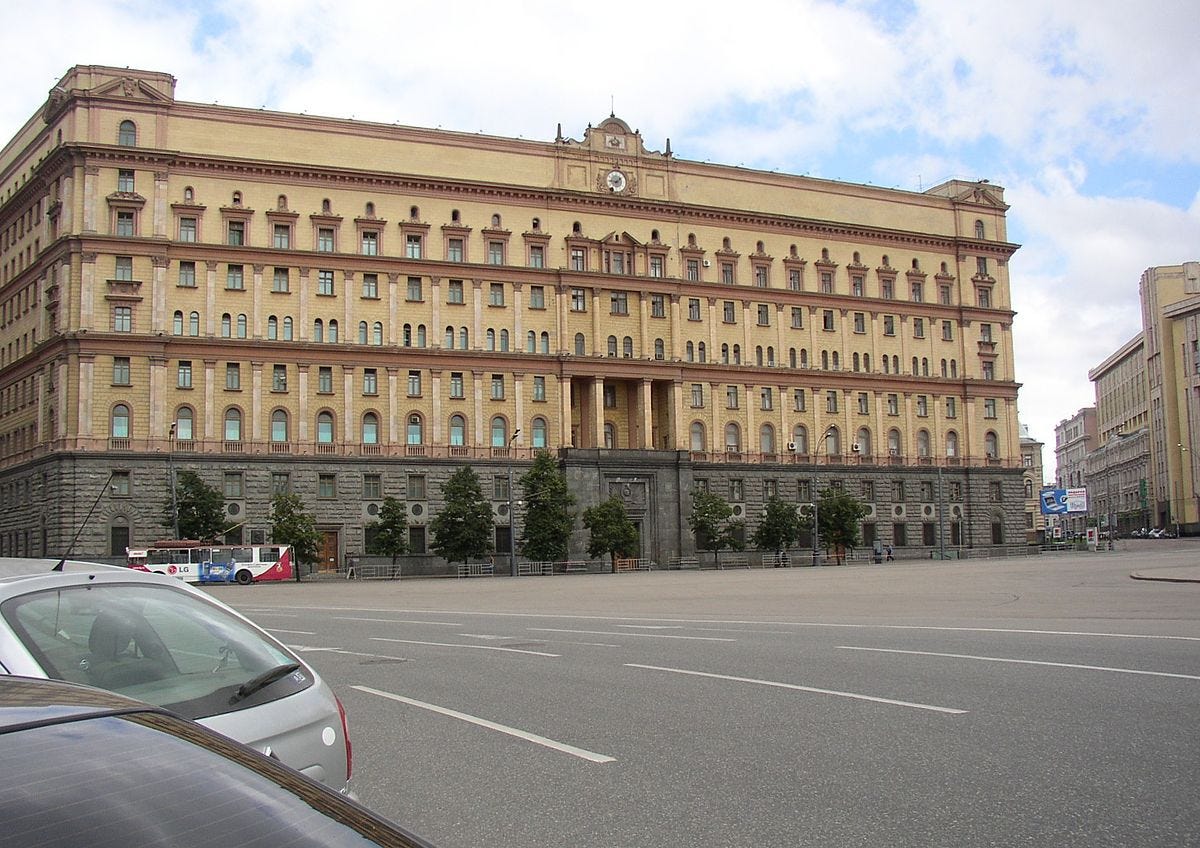
Russian FSB Hqs, Moscow
Only one foreign country has a nuclear arsenal so massive that it poses a “physical” existential threat, is assessed as having enough weapons to wipe out the United States and cause global destruction, and has threatened initial use against the United States: Russia.
Since the end of World War II, the USSR and then Russia has had at best an adversarial and at worst a hostile relationship toward the United States. That hostility has generally been manifested in the form of “active measures:” espionage, subversion, covert funding of left- and right-wing extremist groups, grey and black propaganda, support to violent groups that attack American interests, and general undermining of American foreign relations. For Putin, anything that damages the United States without consequences for Russia is fair game.
Until the advent of the first Trump presidential administration, our government prioritized defense against these active measures. And, for its own part, the US actions in response to Russia have generally been limited to ‘white’ (factual) propaganda, e.g. Voice of America, and support for democratic elements in foreign countries, and the arming of groups that opposed Russian aggression (e.g., the Mujaheddin in Afghanistan) or the Ukraine.
The efforts to defend against Russian active measures have changed radically during the two Trump administrations, leading one to question whether we are abandoning them completely. How does increasing America’s vulnerability to Russian active measures against our country possibly “make America great again?”
One need only take stock of the decisions taken in this administration’s first six months.:
In May 2025, FBI agents working Former Special Counsel Robert Mueller’s Russia investigations were reassigned to border and immigration duties, thus gutting the Bureau’s counterintelligence operations against Russia, leaving the doors open for Russian espionage in the United States. “At the FBI, hundreds of agents have been reassigned to immigration-related duties, raising concerns among agents that the shift could hinder important national security investigations, including into terror threats and espionage by China and Russia, according to people familiar with the matter.” In August, the president deployed at least 120 FBI agents to patrol the streets of Washington, DC, further diminishing the Bureau’s counterintelligence and other operations.
This was accompanied by a unilateral invitation to Russia to ramp up staffing at the Russian Embassy in Washington DC, the key base of Russian, espionage targeting the United States. Veteran CIA and FBI agents say the beleaguered FBI won’t be able to keep up with the threat. No Russian quid pro quo has been exacted, as in either reducing or eliminating the harassment of US personnel at the American Embassy in Moscow or increasing our personnel there.
Russian oligarch’s money is used to support active measures and even as a means to clandestinely pay intelligence or influence agents to fund their operations. Measures put in place by the Biden administration focused on sanctions enforcement and seizing assets of these oligarchs. On her first day in office, Attorney General Pam Bondi disbanded efforts to seize the assets of Russian oligarchs, and switched its focus to border and drug cartels. It also reduced or ceased foreign bribery enforcement. This was followed by a separate directive to halt to a federal law enforcement initiative to combat secret influence campaigns by Russia and other traditional adversaries who attempt to sow division in U.S. politics.
Modern Russian “active measures” and intelligence operations rely heavily on the use of the Internet, so cybersecurity is absolutely vital to protecting American communications, supply chains and critical infrastructure. In any future conflict, cyber-attacks will be a key element of warfare.
Yet the administration has ceased reporting on Russian cyber threats to the US. “Analysts at the Cybersecurity and Infrastructure Security Agency (CISA) have been instructed not to follow or report on Russian threats, even though this had previously been a main focus for the agency.” Similarly, the Department of Defense shut down Cyber Command’s (CYBERCOM) Russia operations. In late February, Defense Secretary Pete Hegseth ordered the U.S. Cyber Command to cease offensive cyber operations and information operations against Russia. It’s unclear how long the order will last. Then on 3 April, the CYBERCOM Commander and National Security Agency (NSA) Deputy Director were dismissed. “The administration inexplicably fired Air Force Gen. Timothy Haugh, head of both the NSA and CyberCom, and the NSA deputy director, Wendy Noble-- both well-respected within the agencies and on Capitol Hill. (This was done amid news reports that a far-right conspiracy theorist bent the ear of the President to ensure their ouster on grounds of perceived disloyalty.) The sudden change of leadership in this key intelligence agency must have caused turmoil and reduced efficiency, and brought a smile to Putin’s face.
Most recently, the Director of National Intelligence (DNI) Tulsi Gabbard has issued a directive prohibiting the sharing of intelligence with our Five Eyes partners [Britain,Canada, Australia and New Zealand] regarding ongoing negotiations between and among the United States, Russia and Ukraine. This action puts at risk the continued sharing of critical intelligence among the US’s closest intelligence partners on which the US security relies –including that concerning Russian offensive operations.
These actions-taken so early in the administration and in such a short timeframe, have already seriously weakened the ability of the US government to protect the country against Russian espionage, subversion, covert funding of extremist groups, propaganda efforts and efforts to undermine American foreign relations.
Why are we letting down our guard against one of America’s most capable adversaries who have proven themselves inimical to our domestic and international security interests?
And this administration still has 1252 days left to make additional such decisions to “make America great again.”
The author is a retired military officer and retired member of the intelligence community with over forty years of apolitical service in the profession.
Founded in 2016, The Steady State is a nonpartisan, nonprofit 501(c)(4) organization of more than 300 former senior national security professionals. Our membership includes former officials from the CIA, FBI, Department of State, Department of Defense and Department of Homeland Security. Drawing on deep expertise across national security disciplines including intelligence, diplomacy, military affairs and law, we advocate for constitutional democracy, the rule of law and the preservation of America’s national security institutions.
This is very thought-provoking, well-researched analysis that connects some very disturbing factual dots. At a time when it would seem obvious to any honest observer that America’s counterintelligence capabilities vis a vis Russia should be strengthened, they are being weakened. Something’s very wrong.