


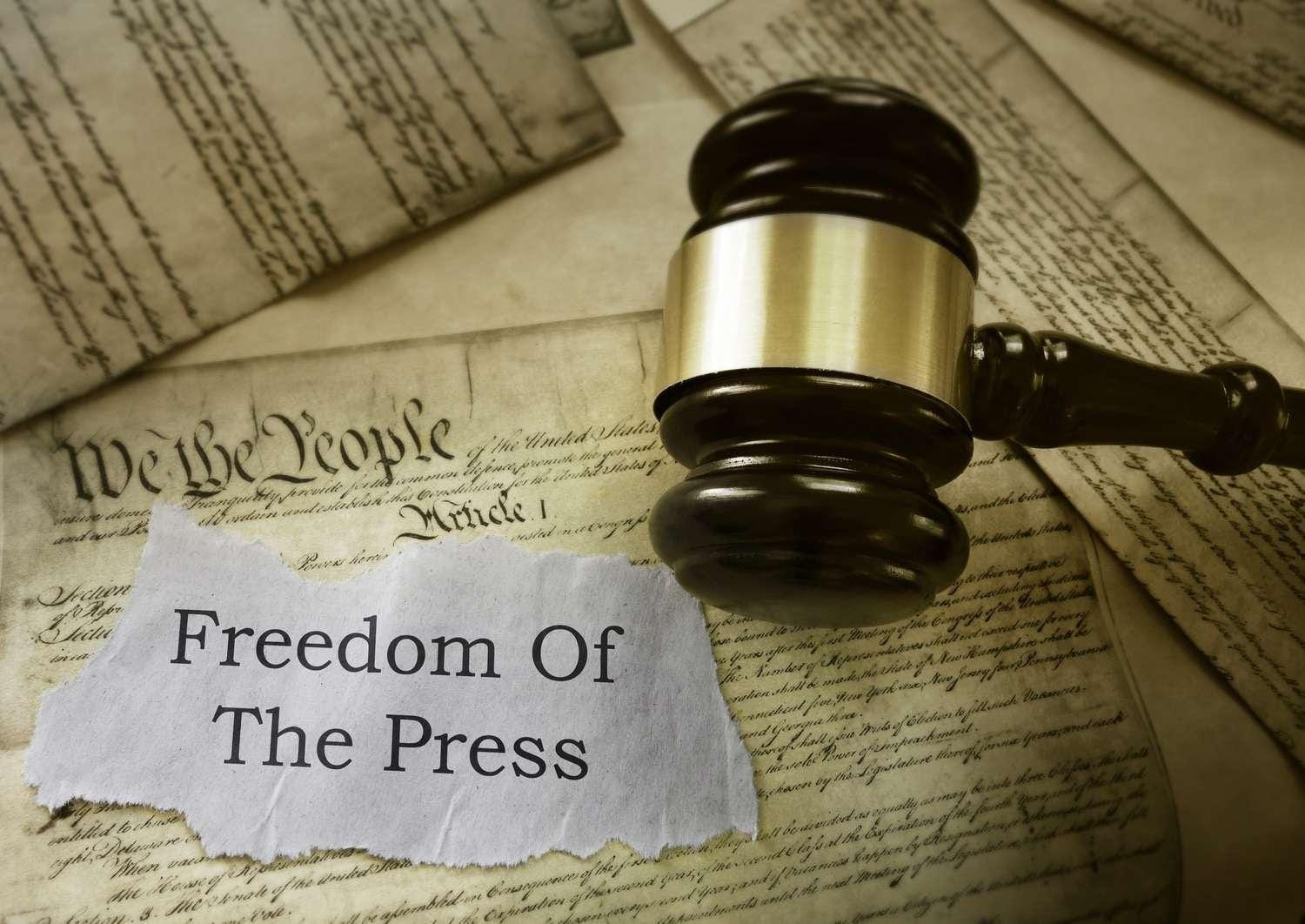
Banning news organizations over unfavorable coverage is part of a familiar authoritarian pattern: delegitimize independent journalists, punish dissenters, elevate friendly media and make access to government dependent on presidential approval. That is precisely why constitutional protections for the press exist.
There are moments in American political life when an action is so revealing that we should stop arguing about the personalities involved and recognize what is actually happening. This is such a moment: President Trump has banned CNN, MS NOW and Politico from the White House because he doesn’t like what they report about him.
That is not simply another chapter in Donald Trump’s decades-long war with the media. It is something more fundamental: the government is deciding which media companies and their journalists are permitted to cover the government based on whether the president approves of their reporting. That is what authoritarians do. And it is precisely why the United States has a Constitution.
The First Amendment doesn’t say that the press has to be nice to the president. It doesn’t say journalists have to be fair in the president’s estimation. And it certainly doesn’t give the president the power to decide which news organizations are sufficiently loyal to receive access to the government they are supposed to cover. The constitutional question before a federal judge on Wednesday is therefore enormously important. As will be Donald Trump’s actions which follow.
CNN, MS NOW and Politico are asking U.S. District Judge Timothy Kelly to temporarily restore their access to the White House while their lawsuit proceeds. They argue that Trump’s decision violates the First Amendment and the Fifth Amendment’s guarantee of due process. Trump has made the rationale for the ban remarkably clear: he says the organizations have published “fiction and lies” and that their coverage is unfair and negative.
The government has legitimate authority to regulate access to the White House. Not every journalist can accompany the president everywhere, and the administration can establish reasonable rules governing press access. But there is a critical constitutional distinction between managing a limited resource and punishing journalists for the content of their reporting.
That distinction has already been addressed in court. During Trump’s first term, Judge Kelly himself, a Trump appointee, ordered the White House to restore CNN reporter Jim Acosta’s press credentials after finding that the administration had failed to provide adequate due process. Other courts have likewise scrutinized efforts by presidents to exclude journalists because of their reporting.
The administration will undoubtedly argue that this case is different; that the president has broad authority to determine who participates in the White House press pool. But the problem is that Trump has not exactly hidden his reasoning. He has publicly tied the exclusion to what these organizations have reported. That is the kind of viewpoint discrimination the First Amendment was designed to prevent.
And then the press pushed back
The consequences of the ban have already gone well beyond three news organizations. Five networks (CNN, ABC, CBS, Fox and NBC) normally rotate responsibility for providing pooled television coverage of the president. When CNN was excluded, the other four networks declined to step in in protest. That is an extraordinary development.
The result was no coverage of Trump’s trip to New York for the United Nations General Assembly. And he was left literally shouting into the wind at a morning ribbon cutting event for his new South Lawn helipad as no one could hear him over the noise of Marine One’s engine.
The White House responded by promoting its own live feed online, calling it “Trump TV,” providing administration-controlled video of the president and his activities, with, to date, the opportunity for comment disabled. Think about that. The president excludes independent journalists he dislikes, the independent television networks collectively refuse to participate in the resulting arrangement, and the White House responds by creating its own tightly controlled operation. Does this sound like American Freedom of the Press to you?
The silence in Congress
Perhaps equally disturbing is the response from Republican members of Congress. Publicly, Republican leaders have largely defended the president’s actions. Vice President JD Vance called the ban “totally appropriate,” and other Republicans have argued that the president has the authority to determine who receives access to the White House.
Yet there are reports of private Republican concern about where this is headed. That disconnect matters. It is one thing for a politician to disagree with CNN or Politico. It is another to privately recognize the danger of government retaliation against the press while publicly defending it because the president of your own party is demanding loyalty.
There is a word for that kind of political behavior: cowardice. And it is dangerous. It is already problematic for a reporter who asks the “wrong question” of this president. Today’s target may be CNN. Tomorrow it could be Fox. Or your local newspaper or radio. Authoritarian governments don’t begin by abolishing newspapers. They begin by delegitimizing journalists, attacking independent news organizations, rewarding friendly media and punishing reporters who refuse to conform. President Trump has checked all three boxes.
A free press is not protected because journalists are always right. It is protected because the government cannot be allowed to determine which journalists are allowed to report on the government.
Our foundational guardrail tested
The United States has something other governments don’t: a Constitution that explicitly protects freedom of the press. The press doesn’t work for the president. The press works for the public. And the president doesn’t get to decide which version of his truth Americans are allowed to see.
On Wednesday, a federal judge will begin deciding whether this president has crossed that constitutional line. For the sake of every journalist who will ever have to hold a president accountable, we should hope the Constitution still means what it says. And then watch whether this president accepts the ruling.

Bruce Berton served as a U.S. diplomat for over three decades, ultimately rising to the senior ranks of the Foreign Service, including two years as Ambassador and Head of Mission at the Organization for Security and Cooperation in Europe’s (OSCE) Mission to Bosnia and Herzegovina. He is a native of the Pacific Northwest and a graduate of Pacific Lutheran University. He is a member of The Steady State.
Founded in 2016, The Steady State is a nonprofit 501(c)(4) organization of more than 450 former senior national security professionals. Our membership includes former officials from the CIA, FBI, Department of State, Department of Defense, and Department of Homeland Security. Drawing on deep expertise across national security disciplines, including intelligence, diplomacy, military affairs, and law, we advocate for constitutional democracy, the rule of law, and the preservation of America’s national security institutions.
Trump TV says it all. And thanks for noting that the boneless chickens in Congress once again might be clucking in private, but they cluck in fear of the increasingly weak Orange Rooster. I hope this also is a sign that the news networks realize that appeasement never works and that they need to maintain a united front.
Very well-reasoned. We really are talking about an unprecedented, fundamental attack on America's core freedoms as enshrined in our Constitution. Putin, Xi and other authoritarian leaders around the world must be loving what Donald Trump and the Republicans are doing to weaken our country.