
Consensus Lost
Non-Proliferation: Consensus Failure - Should we be worried?


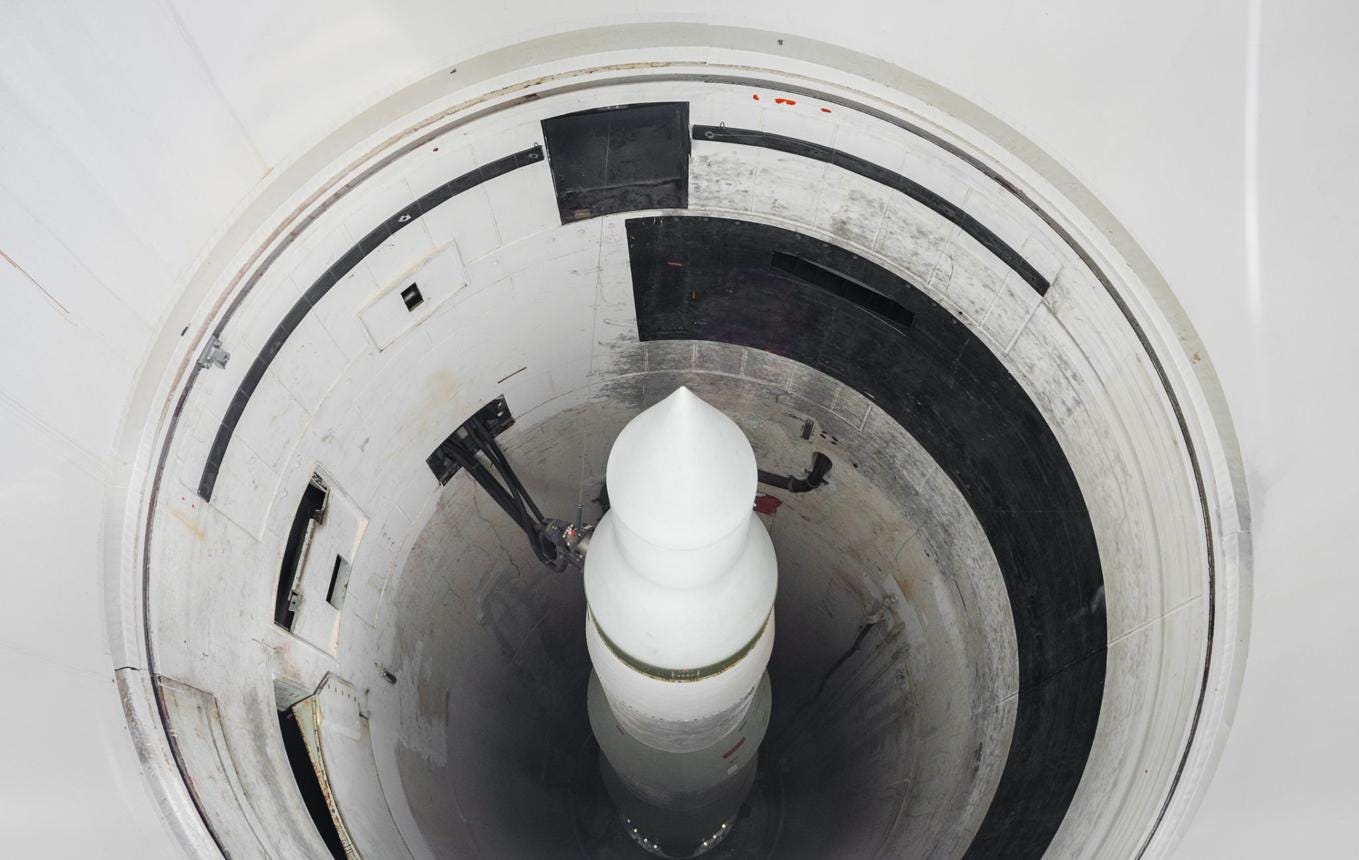
Missile Silo at Minuteman Missile National Historic Site Visitor Center in South Dakota
The collapse of the latest Nuclear Non-Proliferation Treaty Review Conference was not an isolated diplomatic disappointment. It reflected a deeper breakdown in great-power relations, American diplomatic capacity, and the unresolved regional conflicts that increasingly overwhelm nuclear diplomacy.
The inability of the Nuclear Non-Proliferation Treaty (NPT) Five-Year Review Conference to agree on a consensus document at its conclusion last week is very unfortunate for disarmament, nonproliferation, and international security. In reality, the result is disappointing and predictable. Disappointing, as we are now looking at three review cycles that were unable to reach consensus. Predictable because the conference is taking place amid a mix of political, diplomatic, and institutional weaknesses and failures born from previous conferences and new challenges in recent months, including the war in Iran.
This failure to reach a consensus should be attributed to three major issues: geopolitical breakdown among the major powers, diplomatic neglect and atrophy in Washington, and a failure to address longstanding regional flashpoints that drive politics at the NPT.
Geopolitics
For as long as the NPT has existed, it has never been solely about the state of play in nuclear non-proliferation and disarmament. It has also always been a powder keg of the broader health of great-power relations. In the past, the five recognized nuclear-weapon states, who are also the permanent five (P5) members of the UN Security Council, have often sought shared understandings and at least a symbolic consensus as they approached the Review Conference. That effort collapsed before the last Review Conference after Russia invaded Ukraine. When I first joined the Biden Administration as Under Secretary of State for Arms Control and International Security in 2021, there was only one meeting with the P5 at my level. We were able to agree on the extension to all the P5 of the 1985 Reagan-Gorbachev declaration that “a nuclear war cannot be won and must never be fought.” However, soon after the statement was made on January 3, 2022, Russia invaded Ukraine. Also, since that time, New START – the last remaining U.S.-Russia arms control treaty – has expired. Questions remain about China’s goal of increasing nuclear weapons development. Without a bilateral or multilateral strategic agenda to work from, the P5 could not engage in negotiations leading up to this latest Review Conference as it has often done in the past, and could not credibly demonstrate any positive solidarity, even small, on critical normative issues.
Diplomatic Neglect
Arms control and non-proliferation at the State Department have atrophied. Many arms control and nuclear experts in the bureaus I led are no longer at State. The U.S. still has not appointed a dedicated ambassador for the NPT, nor an Ambassador for the Conference on Disarmament (CD). Both Ambassadors, particularly the NPT Ambassador, play a vital role in conducting year-round diplomacy regarding the treaty prior to the conference. Arms control negotiations are technical, historical, and institutional. Negotiating text requires experts on weapons systems, verification mechanisms, the International Atomic Energy Agency, and an understanding of regional conflicts that drive States Parties’ security interests. They also require time; negotiators build consensus outside of formal meetings through decades of personal relationships and information sharing. The ability to successfully negotiate arms control and nonproliferation agreements relies on institutional memory. Experts and foreign service officers who understand the issues at stake, the technical background, regional dynamics, and who have the instincts for compromise when agreements are needed, are in short supply. When those people are fired or forced into retirement, or marginalized, we lose our ability to influence outcomes, convene other parties, and lead coalitions, and we certainly lose our credibility when we demand that others live up to their commitments.
But this is not simply a staffing issue. It goes to a broader question of policy priorities. The emphasis on money and technology at the expense of soft-power instruments, regional and substantive expertise, and frontline diplomatic personnel will continue to lead to failure. Militaries and technological superiority cannot, and should not, substitute for diplomacy. Diplomacy is the only sustainable way to reduce nuclear risks.
Regional and Thematic Flashpoints
Regional issues, regardless of any connection to nuclear issues, have always impacted politics at the NPT. Success has depended upon finding ways to manage many of these disagreements. At the 2022 NPT Review Conference, the death knell for consensus sounded when Russia, in the last three hours before the close of the Conference, refused to agree on issues in the proposed text related to Ukraine. This year, with the Iran war and the Russia-Ukraine war ongoing, all parties arrived in New York knowing there were high-stakes, unresolved disagreements. These cross-cutting issues often overshadow negotiations, showing how delicate consensus can be.
Multilateral negotiations are difficult, complex, and resource-intensive. The U.S. government needs to show that these issues are a priority. We live in a competitive age, and restarting serious dialogue with Russia, China, and others will not be easy. Our interests with countries do not lie solely in money and trade. Those won’t fix these gaps in national security engagements. We should aim to rebuild trust, open crisis communication lines, and create the conditions for initial steps on issues such as transparency, risk reduction, and the constraints on certain types of capabilities and weapons, while at the same time seriously addressing ongoing regional conflicts that impede consensus.. The United States must come to the table with experts and a clear strategy. Stopping the spread of nuclear weapons depends on this.
Ambassador (ret.) Bonnie Jenkins is currently the Shapiro Visiting Professor of International Affairs at the Elliot School of International Affairs at George Washington University. She is also Founder and Executive Director of Women of Color Advancing Peace and Security (WCAPS). Jenkins served as the Under Secretary of State for Arms Control and International Security. From 2009 – 2017, Jenkins served as Special Envoy and Coordinator for Threat Reduction Programs in the Bureau of International Security and Nonproliferation with the rank of Ambassador.
Founded in 2016, The Steady State is a nonprofit 501(c)(4) organization of more than 400 former senior national security professionals. Our membership includes former officials from the CIA, FBI, Department of State, Department of Defense, and Department of Homeland Security. Drawing on deep expertise across national security disciplines, including intelligence, diplomacy, military affairs, and law, we advocate for constitutional democracy, the rule of law, and the preservation of America’s national security institutions.
 | A guest post by |
Much appreciated! This is a serious look at a most serious set of issues. (If there are any intrepid journalists who spot this, this is worth asking the secretary of state and his deputy to respond to. And then, considering the liklihood of getting straight answers, keep asking.)
Great post. One of the consequences of the lack of arms control/nonproliferation is the negative impact on defense planning. Arms control was an important part of improving the DoD planning from the early 1960s. Nuclear forces were rationalized/reduced, modernization could occur with specific parameters, and numbers of weapons and programs could be cut. Broader than nuclear forces the US could eliminate a vast and unnecessary offensive BW program. Beyond improving strategic force planning, arms control also enabled DOD to relocate monies to conventional forces. The absence of arms control/nonproliferation now is contributing to wasted spend on things like Golden Dome.