
Democracy SITREP - Accelerating Authoritarian Dynamics: Assessment of Democratic Decline - A Periodic Update
The Steady State


We assess with high confidence that the cumulative effect of the Trump Administration’s ongoing actions indicates that democratic backsliding continues. While some institutional resistance exists and may be growing, the trajectory poses both immediate and long-term risks to constitutional order and national security.
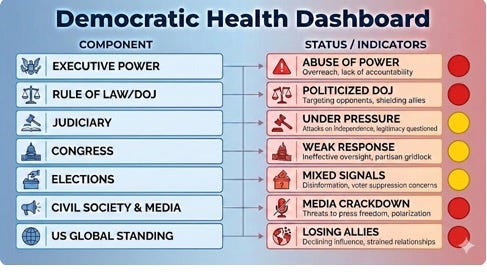
The period from October 1, 2025—January 18, 2026 saw renewed efforts by the Trump Administration to establish autocracy and entrench his cult of personality, likely fearing that his plunging poll numbers, fragmenting political coalition, and a Congress that has finally begun to exhibit a few signs of life place his agenda at risk. President Donald Trump frequently appears befuddled and exhausted, falling asleep in meetings even when his Cabinet is present and praising him, and he lashes out at reporters and politicians (some within his own party) alike. While some recent events offer hope that at least some quarters in our government are waking up, our allies question whether America can ever return to being the reliable ally it once was.
Executive Overreach and the Weaponization of the State
Executive branch overreach remains the key driver of America’s shift toward authoritarianism. Trump on 3 January, without Congressional approval, attacked Venezuela, kidnapping Venezuelan leader Nicolas Maduro and reportedly killing upward of 80 people. Trump insists Venezuelan oil belongs to America, and in a clearly corrupt move set up a bank account in Qatar for the oil revenue, claiming personal control of the funds. Trump also threatened Colombia and Mexico, and threatened to annex Greenland by force if necessary. Even some Republicans in Congress expressed concern about this, with Congressman Don Bacon (R-NE) saying he would lean toward impeachment if Trump moved forward.
Trump’s lust for violence is increasingly taking a domestic focus. ICE operations in Minneapolis are brutal, with officers going door-to-door asking people to identify immigrants, forcing their way into homes without warrants, forcibly removing people from vehicles, throwing flashbangs and tear gas at moving vehicles and injuring children, and, horrifically, shooting a woman in the chest and head, killing her.
Trump increasingly attacks perceived enemies, and his White House has published a “media watch list” naming media outlets and reporters who have been critical of his embrace of authoritarianism and corruption. He accused six members of Congress of sedition and suggested they deserve the death penalty after they made a video reminding the military and intelligence communities that they do not have to obey illegal orders; investigations have been launched into at least two of the six, Senator Mark Kelly (D-AZ) and Senator Elissa Slotkin. Finally, in disturbing displays of misogyny, Trump has attacked female reporters who have asked questions he disliked, calling them degrading names (“stupid,” “piggy,” “obnoxious”) to humiliate and discredit them in front of the American public.
Weakening Judicial Independence
There are some promising signs amid continued moves by the Trump administration to appoint unqualified loyalists to key positions. Efforts by the unlawfully appointed attorney for the Eastern District of Virginia, Lindsay Halligan, to indict New York Attorney General Letitia James were rejected by a grand jury on three separate occasions, and an indictment of former FBI Director James Comey was tossed when an appeals court ruled that Halligan’s appointment was illegal. While this is good news, the administration will likely renew its attempt to charge both.
At the same time, it is clear that Bondi has abandoned even the pretense of a Department of Justice (DOJ) that is independent of the White House. She has operationalized Trump’s executive order naming “antifa” a terrorist organization by nearly eliminating any focus on right-wing, white supremacist groups and turning the focus of the DOJ and FBI toward Trump’s imagined enemies on the left. Under Bondi, the DOJ and FBI will now target individuals or groups that hold what the administration considers “extreme” views on immigration, LGBTQ rights, or “anti-American sentiment.”
Legislative Weakness
Congress continues to delegate much of its constitutional authority to the Executive Branch, ceding its right to check Trump’s power—but signs of life offer some hope. Speaker of the House Mike Johnson ensured Congress would remain ineffective during October’s long government shutdown—sending House members home and refusing to swear in Arizona’s new representative, Adelita Grijalva, for seven weeks, probably fearing Trump’s wrath if the House voted to release the Epstein files. However, outrage from the public—which likely prompted sudden, inexplicable support from Trump—forced Johnson to not only reverse his stance on the release of the files, but to vote for it. The DOJ is dragging its feet on the release of the files, however, and Johnson refuses to press for compliance with the law.
Systemic Electoral Flaws
We remain concerned by gerrymandering efforts that continue apace, but there are positive signs that, at least in some quarters, the electoral system holds. While Texas moved forward with redistricting efforts meant to help Republicans ahead of the 2026 midterms, Indiana Republicans rejected such a measure, much to the ire of President Trump, who threatened to cut off all federal aid to the state. Kudos to the Indiana Republicans who stood for the rule of law in the face of threats to their safety. In addition, there was no effort to delegitimize November elections that were swept by Democrats, including hotly contested governor’s races in New Jersey and Virginia.
Undermining Faith in Public Institutions
We assess that Trump’s assault on democratic institutions continues to weaken Americans’ belief in a constitutional republic. Investigations into Trump’s political opponents (e.g., Comey, James, former CIA Director John Brennan, former Director of National Intelligence James Clapper, the “seditious six”) are meant to convince his base that government agencies that form the foundation of our republic are run by a “deep state” that attempts to subvert the will of the people. Threats to revoke the citizenship of naturalized citizens—including elected officials like Representative Ilhan Omar (D-MN) or New York City Mayor Zohran Mamdani—are meant to terrorize anyone not born here, undermine the foundational concept “out of many, one,” and suggest to non-white, naturalized Americans that they do not merit representation in Congress. This also undermines Americans’ belief in a multicultural democracy based on ideas and shared values, not ethnicity.
Trump continues to undermine support for higher education by suggesting admission is not merit-based, that widespread anti-semitism exists, and that scientific research is biased. He uses federal funding to leverage universities into compliance with his views of “DEI” and to extort funds in the form of “settlements” or “fines” for offenses that were never established. Unfortunately, several universities have chosen to cave to his demands in order to receive research funds. Northwestern University recently agreed to pay $75 million over three years in order to restore hundreds of millions in federal funds. Columbia, Cornell, Brown, Penn, and the University of Virginia have entered similar agreements, with Penn only agreeing to modify the records of transgender swimmers, and UVA only agreeing to follow DOJ’s interpretation of civil rights laws.
Trump has also made a mockery of the pardon power, pardoning former Honduran President Juan Orlando Hernandez, who was extradited to the US in 2022 and convicted of trafficking hundreds of millions of dollars of cocaine into the US. Trump also pardoned David Gentile, sentenced to seven years for conspiring to defraud investors of $1.6 billion. Gentile served only two weeks, and will not have to pay millions in restitution. In a calculated attempt to reward a political ally, he “pardoned” convicted Colorado election clerk Tina Peters—who was convicted on state charges of election interference and sentenced to nine years in prison.Trump cannot issue pardons for state offenses. And in a craven admission of the rationale behind these pardons, Trump rebuked Representative Henry Cuellar (D-TX)—pardoned by Trump in a bribery case—for not switching parties to repay him.
Continuing the Administration’s dangerous assault on soft power, the State Department notified at least two dozen senior diplomats—career foreign service officers who served both Republican and Democrat administrations—that they must depart their posts in early January. Upon their departure, more than half of US embassies will lack a confirmed ambassador, dramatically eroding America’s ability to exert influence overseas.
Assault on Public Knowledge and Civil Society
Trump continues to attempt to create a new reality in which truth and facts do not exist in themselves, but are whatever Trump insists they are. This will weaken America’s role as a leader in medical and scientific research and eventually make us a less attractive option for foreign talent. We have seen this in the administration’s attacks on American universities, as well as lies about the efficacy and risks of vaccines—most recently the decision to recommend against vaccinating newborns against hepatitis B.
Focused on helping Trump shore up his shaky personality cult, Trump’s handpicked board of directors at the Kennedy Center—almost certainly at his behest, as Trump has long mused about adding his name to the Center—voted to change the name of The Kennedy Center to “The Donald J. Trump and The John F. Kennedy Center.” Several dozen performers promptly backed out of scheduled performances. Trump has also ended the leases of public golf courses near D.C, and mulled a second floor above the West Wing. These actions—especially when viewed with his aggressive foreign agenda—suggest he is primarily obsessed with establishing a legacy, and envisions remaking not only America’s political landscape, but its public landscape as well.
Founded in 2016, The Steady State is a nonprofit 501(c)(4) organization of more than 360 former senior national security professionals. Our membership includes former officials from the CIA, FBI, Department of State, Department of Defense, and Department of Homeland Security. Drawing on deep expertise across national security disciplines, including intelligence, diplomacy, military affairs, and law, we advocate for constitutional democracy, the rule of law, and the preservation of America’s national security institutions.