
Expect More Summonses
The Steady State | by Adam Wasserman

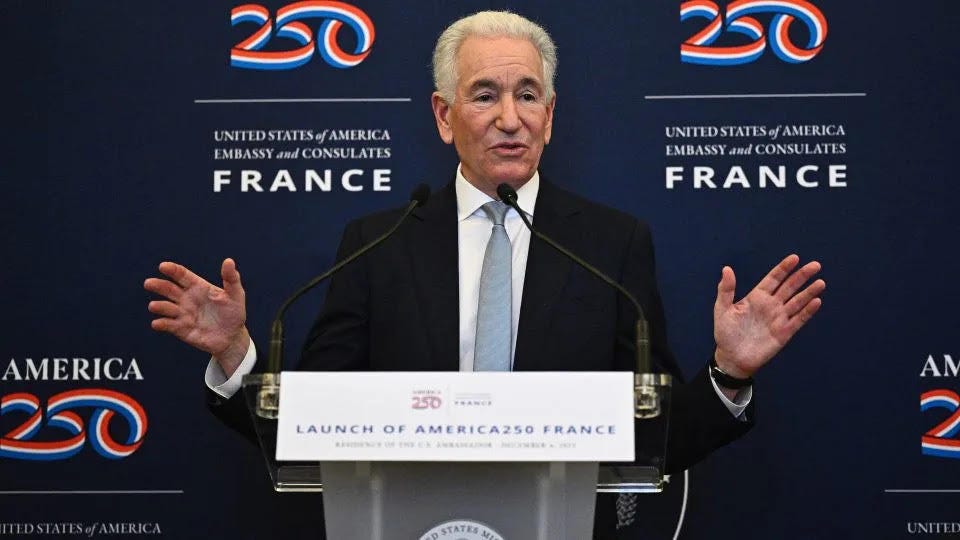
A strange thing happened a few weeks ago in US-French relations. The French Foreign Minister summoned the US Ambassador for a meeting. This kind of summons happens when there is serious tension between two countries, or when the Ambassador has said or done something controversial. While not common, a summons is a normal part of diplomacy.
The strange thing was not the summons, it’s that the American Ambassador didn’t show up, a serious breach of protocol. In response the Foreign Ministry barred him from meeting with French officials.
What was the source of the tension? The Embassy weighed in on a purely domestic issue, the recent killing of a right-wing activist in a demonstration in Lyon. The Embassy used X (formerly Twitter),to make a statement: “The information, corroborated by the French Minister of the Interior, according to which Quentin Deranque would have been killed by far-left militants, should concern us all. Violent left-wing extremism is on the rise, and its role in the death of Quentin Deranque demonstrates the threat it poses to public safety.” Deranque’s death has become a cause celebre for right-wing groups around Europe, although—as in the US—studies show that the vast majority of political violence in Europe is perpetrated by the right.
A few days later the Ambassador’s meeting privileges were restored, with the Foreign Ministry excusing him on the basis of his lack of diplomatic experience. Who is this inexperienced diplomat? The Honorable Charles Kushner, appointed in July, is the father of Jared Kushner, President Trump’s son-in-law. Charles is a real estate developer with a past that even the French, used to dealing with inexperienced political appointees, must have found troubling. He was convicted and jailed in 2000 on charges of tax evasion and threatening a federal witness; Trump pardoned him in 2020. Now he is the face of America in Paris.
This was not Mr Kushner’s first un-diplomatic foray into France’s domestic politics, however. Last August he was also summoned, and also failed to come, over an op-ed criticizing France for not doing enough to combat anti-semitism: “Public statements haranguing Israel and gestures toward recognition of a Palestinian state embolden extremists, fuel violence, and endanger Jewish life in France. In today’s world, anti-Zionism is antisemitism—plain and simple.” The Foreign Ministry called this unacceptable interference in France’s domestic affairs.
Intervening in sensitive domestic issues is not confined to Paris. In Belgium, US Ambassador Bill White was recently summoned after weighing in on a controversy over regulations on circumcision, tweeting: YOU MUST DROP THE RIDICULOUS AND ANTI-SEMITIC ‘PROSECUTION’ NOW OF THE 3 JEWISH RELIGIOUS FIGURES (MOHELS) IN ANTWERP!” (All caps! Where did he learn that?) Unlike Mr Kushner, White showed up, but continued to make comments that prompted a Belgian MP to say “After an ambassador is summoned, he is expected to remain silent. This man does not. If he persists in his outrage, he risks violating the UN Charter and customary international law.”
Ambassador White too has a controversial past. A vocal election denier, he once paid a $1 million fine in a New York pension scandal. During his confirmation hearing he was criticized by Senator Tim Kaine for using his X account to post support for Dries Van Langenhove, a far-right Belgian activist and holocaust denier who was convicted for violating laws surrounding racism and historical falsification.
In Poland US Ambassador Tom Rose, again using X, posted in early February that he was breaking off ties to the leader of parliament because of his refusal to support Donald Trump for the Nobel Peace Prize: “Effective immediately, we will have no further dealings, contacts, or communications with Marshal of the Sejm Czarzasty, whose outrageous and unprovoked insults directed against President Trump @POTUS has made himself a serious impediment to our excellent relations with Prime Minister Tusk and his government.” Afterwards Tusk wrote that allies should “respect each other, not lecture each other.” Rose is a former talk show host and publisher whose nomination was criticized in Poland because of his record of support for Tusk’s right-wing predecessor, Andrzej Duda.
European governments are also responding to American meddling by powerful private actors. In Great Britain, Elon Musk has ramped up his attacks on Prime Minister Starmer, and doubled-down on his support for far right activist Tommy Robinson, founder of the anti-Islamic English Defense League. British politicians strongly criticized Musk after a September rally organized by Robinson, where Musk called for parliament to remove Starmer and warned participants to be ‘ready for violence.’ Starmer’s Labor Party last month introduced legislation to tighten foreign campaign donations, due in part to Musk’s reported plan to give $100 million to Nigel Farage’s right-wing Reform UK party.
In France, authorities last week searched X’s offices as part of a probe into interference in domestic politics. In France and the UK investigations are underway into X and Grok AI’s dissemination of sexual images and holocaust denialism.
Different understandings of free speech and the limits of political expression are central to many of these disagreements. The European Commission and individual states have legal guardrails against hate speech that the US, under the First Amendment, is barred from regulating.
The Trump administration has called for Europe to imitate the US by relaxing regulations on hate speech, limits on campaign donations, and restrictions on online platforms. Vice-President Vance in his Munich speech last year cited a long list of incidents to support his claim that “In Britain and across Europe free speech, I fear, is in retreat…”
The underlying reason for these critiques is not concern for liberty or the democratic values and interests of the United States, but political. MAGA sees these restrictions as disproportionately affecting its right-wing political allies in Europe. Ambassadors like Kushner signal Washington’s contempt for actual diplomacy; they are there to undermine our fellow democracies, not work with them, by amplifying claims of antisemitism and liberal bias. Their job, under the autocratic Trump administration, is to put Europe’s liberals on notice by acting the same way their bosses do at home: communicating loudly on social media and violating democratic norms to get attention. Expect more summonses.
Adam Wasserman is a retired CIA analyst with experience on failing democracies in the former Soviet Union, the Middle East, and Southeast Asia. He served on the State Department Policy Planning Staff, the CIA Red Cell, and the National Security Council staff. He is a member of The Steady State.
Founded in 2016, The Steady State is a nonprofit 501(c)(4) organization of more than 390 former senior national security professionals. Our membership includes former officials from the CIA, FBI, Department of State, Department of Defense, and Department of Homeland Security. Drawing on deep expertise across national security disciplines, including intelligence, diplomacy, military affairs, and law, we advocate for constitutional democracy, the rule of law, and the preservation of America’s national security institutions.
They should send our MAGA ambassadors home. Just too polite to do it -yet.
To cite the late Cokie Roberts (whom we really need back): "Were these people born in a barn? Where were their mothers?"