
Important Stuff to Know About - The Defense Strategy That Will Shape Your Future, Whether You Know it or Not
A Steady State Firepit Publication | by Martha Duncan


Most Americans have never heard of the National Defense Strategy.
That isn’t an accident. It’s long. It’s technical. It’s buried in government websites. And it almost never gets explained in plain English.
But here’s the reality: this document will shape how safe the United States is five, ten, and twenty years from now — long after today’s political headlines are forgotten.
If you want to know where the country is actually going on national security, you don’t watch campaign speeches. You read strategy documents.
Because that’s where governments reveal what they are really preparing for.
Where the Real Decisions Get Made
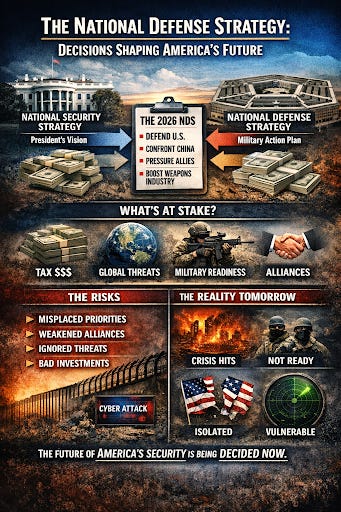
There are two documents that quietly drive U.S. national security policy.
The National Security Strategy (NSS) comes from the White House. It tells you how the president sees the world — who matters, who threatens us, and what America is supposed to do about it.
The National Defense Strategy (NDS) comes from the Pentagon. It turns that worldview into military reality: what weapons get built, where forces deploy, how alliances are structured, and what threats get priority.
If the NSS is the theory, the NDS is the execution plan.
And execution plans are where history gets written.
The 2026 Strategy Looks Normal — Until You Look Closer
The 2026 National Defense Strategy centers on four major goals:
Defending the U.S. homeland
Competing with China
Forcing allies to carry more of the defense burden
Expanding U.S. defense manufacturing
On paper, that sounds reasonable. Almost boring.
But strategy is never just about what’s listed. It’s about what gets emphasized — and what gets quietly pushed to the side.
And that’s where the stakes get real.
The Fight Inside the National Security World Right Now
There is a growing argument among defense professionals that the strategy is drifting toward domestic political framing rather than long-term global risk management.
The NSS provides a strategic outline of what the U.S. wants and the strategy for achieving it. It assesses immigration as a potential threat vector and describes border security as the primary element of national security. Meanwhile, threats like cyber infrastructure attacks, global supply chain disruption, pandemic risk, and climate-driven instability receive comparatively less attention.
You don’t have to agree with that argument to recognize the danger.
Strategy is about prediction.
Prediction is about prioritization.
And when governments mis-prioritize threats, they don’t fail immediately. They fail later. Usually, during a crisis.
This Isn’t Abstract. This Is About Power, Money, and Risk.
The National Defense Strategy decides:
Where hundreds of billions of taxpayer dollars go.
Which weapons systems get built.
Which threats agencies train to respond to.
Which alliances strengthen — and which quietly erode.
And those choices compound.
If you overinvest in one category of threat and underinvest in another, you might not notice at first, until something happens. Then, suddenly, you realize the country is incredibly well prepared, but for the wrong war.
History is full of those moments.
The Alliance Issue Should Worry People More Than It Does
For eighty years, alliances have been America’s strategic superpower.
Allies share intelligence.
They host bases.
Their existence deters conflicts before they start.
But alliances are built on trust — not just capability.
If allies start to doubt U.S. strategic judgment and resolve, cooperation won’t collapse overnight. It might get slower. Narrower. More conditional.
And in a crisis, slower, narrower, conditional can be deadly.
Strategy documents are read line by line in allied capitals. They are read just as closely by adversaries.
Everyone is trying to answer the same question:
What does the United States actually care about now?
The Most Dangerous Myth: Strategy Only Describes Today
It doesn’t. Strategy is about what the government thinks the world will look like years from now.
Weapons systems take a decade to develop.
Military doctrine takes years to institutionalize.
Alliance networks take generations to build — and can be damaged in months.
When your strategy is wrong, you don’t notice immediately.
You notice when it’s too late to fix quickly.
Why This Is a Democracy Issue — Not Just a Defense Issue
Most Americans will never read the National Defense Strategy. That’s fine.
But people should at least understand what it does.
Because these decisions shape:
Economic stability
Global influence
Military readiness
Crisis response capability
Long-term national survival
National security policy is one of the few areas where mistakes can echo for decades.
And, the less public attention these documents get, the easier it is for strategic choices to be made with minimal scrutiny.
If You Want to Understand the System Better
If you want a strong, accessible breakdown of how these strategy documents fit together, Paul Cobaugh’s article What Is the NDS, and Why Does It Matter? is a very good place to start. It translates dense doctrine into plain language without pretending the stakes are small.
The Bottom Line
The National Defense Strategy will never go viral.
It will never dominate cable news.
But it will quietly determine what kind of threats the United States is ready for — and which ones it isn’t.
And if citizens don’t understand at least the basics of how it works, they are giving up one of the most important forms of democratic oversight they have.
Whether they realize it or not.
Martha Duncan is a retired U.S. Department of Defense senior executive with 37 years of service, including 23 years as an officer in the U.S. Army Reserves, where she also served as Reserve Attache. She had three operational deployments to Panama, Bosnia, and Afghanistan. At DIA, she worked as a Latin American analyst for 11 years. A specialist in human intelligence (HUMINT), she is recognized for her leadership in intelligence operations, coalition-building, and enterprise-level policy development across the Defense Intelligence Agency (DIA), the U.S. Army, and the broader Intelligence Community. She grew up in Panama during the rise of Manuel Noriega and was instrumental in his capture. She is a member of The Steady State.
Founded in 2016, The Steady State is a nonprofit 501(c)(4) organization of more than 360 former senior national security professionals. Our membership includes former officials from the CIA, FBI, Department of State, Department of Defense, and Department of Homeland Security. Drawing on deep expertise across national security disciplines, including intelligence, diplomacy, military affairs, and law, we advocate for constitutional democracy, the rule of law, and the preservation of America’s national security institutions.
Seems to me that the targeted enemy by this administration are domestic citizens who don’t go along with its fascist agenda.
👍🏾 👍🏾 I’d be interested in your assessment of Trump, et.al.’s new “Strategy”. Seems to me it may have already fatally damaged every aspect of America’s reputation and standing wherever it manifests itself.