
Iran Defeats America
Trump’s war may be remembered as the moment America surrendered its strategic advantage in the Middle East.


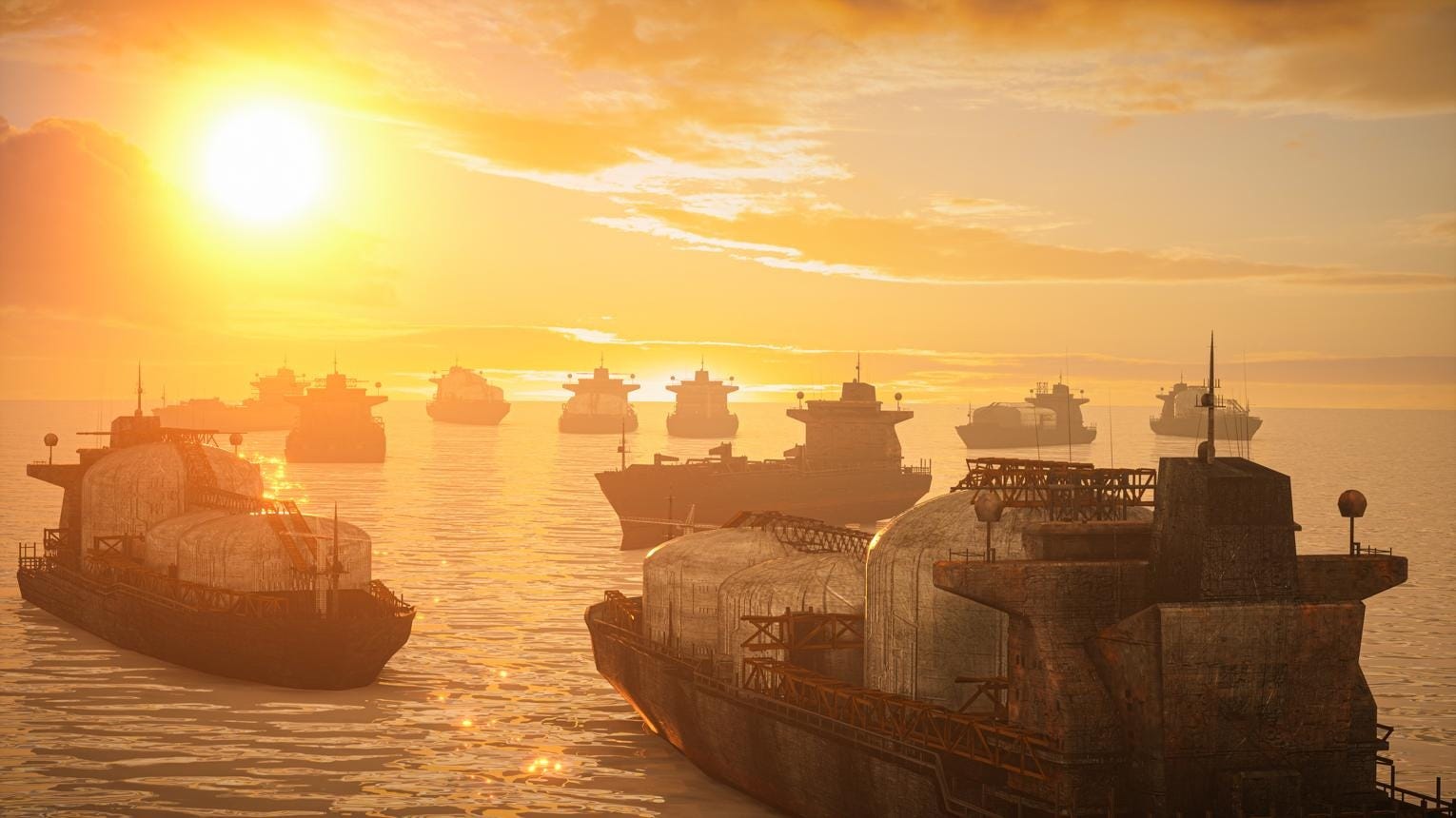
Oil Tankers Anchored in the Strait of Hormuz
Trump promised to reshape the Middle East and break Iran’s power. Instead, the war risks producing the opposite outcome: an Iran that retains strategic leverage, a China poised to exploit American missteps, and a United States struggling to preserve the maritime order that has anchored its prosperity and influence for more than a century.
Trump Has Failed to Achieve His Objectives
No, this is not a World Cup result. Nor is it a future headline about the current war. It may, however, be the title of a history book published in a few years that looks back on America’s war against Iran. We are unlikely to see dramatic evidence of defeat like Kabul in 2021 or Saigon in 1975. Instead, the damage will unfold over months and years, and it will be historians who write the obituary of Trump’s folly — even as we see the effects playing out today, evidenced by President Xi’s almost big-brotherly treatment of Trump at last month’s summit and Netanyahu apparently ignoring Trump’s appeal to not retaliate against Iran’s missile attacks of 6-7 June.
The US is now in a strategic cul-de-sac. Perhaps the only narrow path out is a reopened Strait of Hormuz and a return to something broadly akin to the 2015 nuclear deal Trump foolishly withdrew from in 2018. Trump has failed in all his other objectives: regime change, severing Iran’s ties to terrorist and insurgent groups, destroying its missile program, and crippling its military capability. Iran’s conventional air and naval forces have been devastated, but its unconventional capacity is intact. Even Israel’s long-term security has not improved, despite near-term gains from a weakened Iran.
Defeat More Likely Than a “Tie”
Extricating the US from this cul-de-sac requires diplomatic skill, patience, acuity, flexibility, a willingness to compromise publicly, and an acknowledgment of failure. These are not hallmarks of the Trump administration, which has weakened the State Department, denigrated expertise, and relied on real estate builders as negotiators. Trump also lacks the necessary leadership attributes, as documented in The Steady State’s recent assessment of Trump’s leadership. (Trump Unleashed: Leadership Patterns and Implications in the Second Term, April 13, 2026).
This will require a well-grounded policy, not positions altered daily for ego or the MAGA base. It requires understanding that for Tehran, there is more to a deal than just money — and that other countries have real stakes in this global issue. Most importantly, Trump must accept a nuclear agreement that, at best, returns us to where President Obama had us. None of this is likely, so future historians are more apt to write “Iran Defeats America” than credit the Trump administration as a 21st-century Bismarck.
The likely outcome: the Strait of Hormuz eventually reopens, but with Iran holding a recognized role in controlling its operations and retaining its residual nuclear capability in exchange for sanctions relief and a pledge not to weaponize. The war will have been for nothing. Iran retains nuclear latency, the principle of an open Strait is weakened, and the US is pried out of its leading regional maritime role.
Weakened US Power Driven by Strategic Incompetence
Trump’s Iran folly will diminish US power — not because other countries have lost respect for American military capability, which the war has demonstrated is formidable, but because of strategic incompetence at the national leadership level. President Nixon reportedly had a simple formula for national power: capability times will. He assumed basic competence. For the current administration the formula must be modified: capability times will times competence. It does not matter how capable the military is, how strong the economy is, or how much raw determination is on display if these tools are wielded incompetently. Trump and his coterie may believe they are all-powerful; the rest of the world is increasingly perceiving a muscled behemoth with no brain.
Iran could be on the cusp of demonstrating to the world that the US can no longer be trusted to assure a secure, free, and open maritime environment. This is not because of US military failure, but because Teheran’s national leadership (even its second team, the first died in the war) has just a bit more strategic acumen than Trump and Co.
Long-Term Damage to US Maritime Power?
Past US defeats came in land-based counterinsurgencies and did not threaten core foundations of American power. This defeat could. Open sea security backed by US naval forces has been central to American power for a century. The free flow of oil through the Persian Gulf has driven national strategy since the late 1970s. Were that principle altered, other countries could perceive a foundational strategic defeat.
Iran, as a Strait of Hormuz littoral state, would have established the precedent of dominance over a body of water previously considered free and open. Others may take this precedent, especially in light of the US’s failure to prevent it, and expand their control of open seas in their littoral areas, directly challenging the international community and the US to reverse their actions.
These ripple effects would extend well beyond the Gulf. Countries in South and East Asia — already suffering from reduced oil flows and heavily dependent on secure, open oceans for trade — would be forced to re-examine their strategic posture toward the US. An American strategic defeat against Iran would undermine their assumptions and push them to seek alternatives. China is poised to benefit. Its claims to large swaths of the South and East China Seas have been resisted partly on the strength of the principle of free and open oceans, with the US as guarantor. Iran establishing a controlling role over the Strait would strike a serious reputational blow, and countries throughout Asia would look to cut deals with Beijing. This could position China to dominate sea lanes from the Strait of Malacca to Japan and South Korea.
Consequences for US Prosperity
The US economy is heavily dependent on international trade, so a secure, free, and open maritime environment is essential to US security and prosperity. This has been a foundational pillar of US national security since the Marines stormed the Shores of Tripoli in 1805. As the US war against Iran (with the resulting halt in oil and gas shipments) demonstrates, maritime interdiction anywhere in the world has a direct impact on the US economy, even though the US imports less than 10 percent of its oil from the Persian Gulf. While only 14 percent of US trade transits the South China Sea (SCS), an estimated one-third of all global shipping transits through this area. Were China to be able to dominate the SCS, it would gain economic and political leverage over the region and the US. China has shown a clear proclivity to throw its weight around to benefit its political and economic power and wealth at the expense of others. The current pain of the ongoing Iran war may pale compared to a future of China controlling Asian trade.
Trump’s Iran Folly Will Reverberate Globally
Given Trump’s leadership attributes, the patient and flexible diplomacy needed to extricate the US from its Iran cul-de-sac is unlikely. The administration has neither the strategic depth nor the institutional capacity to negotiate its way to a credible outcome. It is time to begin thinking seriously about managing the consequences — consequences that could reverberate around the world even as it takes years for the full effects to be felt.
The war was sold as a show of American strength. It may well be remembered as the moment the world stopped assuming American leadership.

Harry Hannah retired after four decades of experience in the Intelligence Community. He retired from the CIA in 2018. About half that time was focused on analyzing the capability of multiple foreign militaries in direct support of US military planning and operations and national level decision making. He is a member of The Steady State.
All statements of fact, opinion, or analysis expressed are those of the author and do not reflect the official positions or views of the US Government. Nothing in the contents should be construed as asserting or implying US Government authentication of information or endorsement of the author’s views.
Founded in 2016, The Steady State is a nonprofit 501(c)(4) organization of more than 400 former senior national security professionals. Our membership includes former officials from the CIA, FBI, Department of State, Department of Defense, and Department of Homeland Security. Drawing on deep expertise across national security disciplines, including intelligence, diplomacy, military affairs, and law, we advocate for constitutional democracy, the rule of law, and the preservation of America’s national security institutions.
 | A guest post by
|
A particularly cogent and succinct summary of how Trump's folly will diminish US power, influence and security in many areas. It is also likely that as the US becomes "smaller" in many of these areas of power and influence, other countries will step in to fill the vacuum. France has already "offered" to provide a nuclear deterrent "guarantee" to take the place of the former US role in NATO. Many countries are offering U.S. researchers who lost funding the opportunity to move their work abroad and resume cutting edge research. In the area of the development of "green" climate friendly innovation, Trump has surrendered the field, but many countries are rushing ahead with the research which will render America as a "left behind" in and non-player competition for new technologies.
Outstanding analysis and assessment. Typical of what my CIA (in the 80s and 90s) produced on a daily basis.