
Just…Because He Can?
Trump, military force, and the moral limits of war


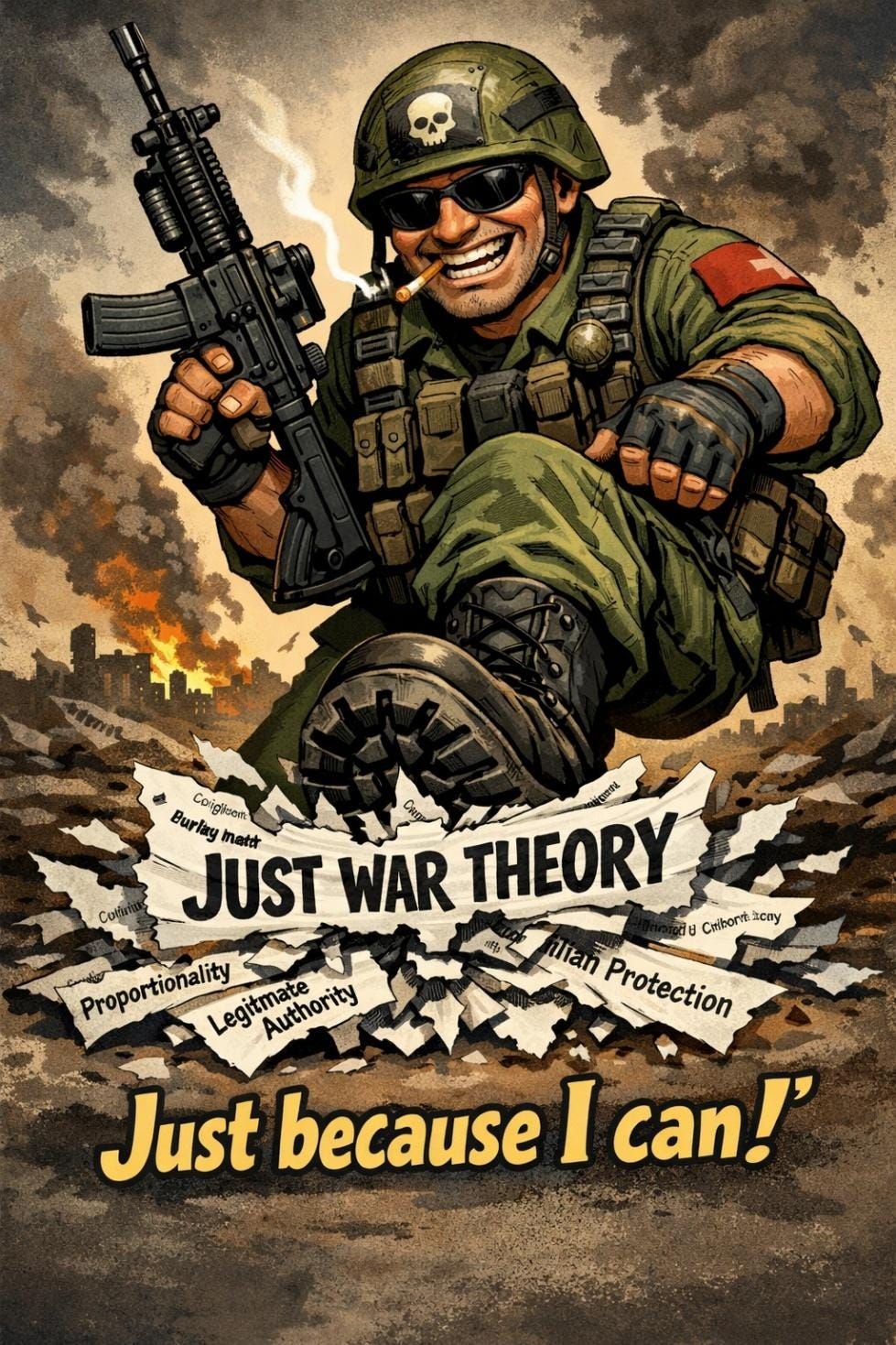
The danger is not merely unjust war, but the normalization of military force without rigorous moral or constitutional examination. Recent U.S. operations suggest that threshold is eroding.
The Just War Theory is a moral framework for judging when the use of military force is morally justified, and how it should be ethically executed. It begins by recognizing that, while war is inherently destructive, it can be justified under certain conditions. The concept of just war has its roots in classical Roman and Hebrew culture and was further refined by early Christian theologians and philosophers, such as St. Augustine and Thomas Aquinas.
The theory distinguishes between jus ad bellum, or the justice of going to war, and jus in bello, or justice in the conduct of war. Recently, jus post bellum, addressing post-war justice and reconstruction, and ensuring that victors don’t manipulate history to justify unjust actions, has been a consideration as well. The primary criteria for entering war are usually listed as just cause, legitimate authority, right intention, last resort, probability of success, and proportionality. Once force is used, the primary concerns become discrimination between combatants and noncombatants and the avoidance of excessive harm. While these standards don’t completely eliminate disagreement, they do offer a disciplined way to assess military action beyond slogans, fear, or partisan rhetoric.
This leads us to my main concern, which is whether the military attacks on alleged drug boats in the Caribbean and eastern Pacific, and the U.S.-Israeli attacks on Iran, are just or unjust wars.
Are alleged narco-terrorists legitimate combatants?
When the Just War Theory is applied to Trump’s campaign against alleged drug-trafficking boats in the Caribbean and eastern Pacific, immediate doubts are raised. It can be logically argued that transnational cartels threaten public safety and that narcotics contribute to thousands of deaths in the United States. But Just War Theory sets a high bar for using lethal force. A just cause usually requires defense against an actual or imminent armed attack, not simply the existence of criminal activity with terrible social consequences.
The military has also provided limited public evidence that the targeted boats were actually carrying drugs or that they posed any kind of imminent threat. This matters morally because if the factual basis for the strikes is uncertain, then the claimed just cause becomes weaker. So does the requirement of right intention, since a campaign can appear aimed as much at deterrence, spectacle, or domestic political messaging as at immediate self-defense.
It is also difficult to satisfy other just war criteria in this campaign. Legitimate authority is always in question whenever the president initiates sustained military action without clear congressional approval. Lack of action by a quiescent GOP-controlled Congress is hardly a definitive approval. Last resort is also a serious issue. Interdiction, arrest, intelligence cooperation, sanctions, and prosecution are the traditional tools used against drug trafficking, and Just War Theory asks whether such alternatives were truly exhausted before lethal force was used. The sharpest concern, though, is proportionality. Even if disrupting drug trafficking is a valid state objective, destroying small boats and killing suspects at sea can be morally disproportionate if the threat was not immediate and capture was realistically possible.
This operation fits awkwardly, at best, within the definition of just war. It looks more like an aggressive extension of counterdrug policy into warfare than a clear case of morally necessary and acceptable armed defense.
Is Trump’s Iran ‘Excursion’ a just war?
The joint U.S.-Israeli attack on Iran is more complicated than the Western Hemisphere operation, but it’s equally hard to neatly classify as just war.
The strongest possible justification is that it was an act of self-defense or collective self-defense in response to ongoing or imminent armed attacks. If that’s accurate, the operation might satisfy just cause more plausibly than the maritime drug-boat campaign. But Just War Theory also asks whether the threat was immediate, whether the aims were limited, and whether nonmilitary options had been exhausted. If the attack was primarily preventive, intended to degrade future capability rather than to stop an imminent attack, many just war thinkers would be skeptical. Questions about constitutional authority and international legality further muddy the issue of legitimate authority. And because the attacks on Iran risked broader regional escalation, the proportionality test is especially demanding.
To put it bluntly, Just War Theory doesn’t provide a simple yes or no verdict, but it does suggest that these operations occupy uncertain moral ground. The anti-drug strikes are especially difficult to reconcile with the traditional standards of just cause, last resort, and proportionality. The Iran campaign has at least a modest claim, if viewed narrowly as self-defense against an immediate attack, but no evidence has been offered to authenticate it. And even that justification weakens if the operation was preventive, open-ended, or not legitimately authorized.
If the U.S. Congress were doing its job of exercising oversight of the Executive rather than bending a knee to Trump’s whims and demands, these operations, which are not unequivocally just wars, would be analyzed and debated, rather than hanging in an ethically and legally contested status.
Charles A. Ray served 20 years in the U.S. Army, including two tours in Vietnam. He retired as a senior US diplomat, serving 30 years in the U.S. Foreign Service, with assignments as ambassador to the Kingdom of Cambodia and the Republic of Zimbabwe, and was the first American consul general in Ho Chi Minh City, Vietnam. He also served in senior positions with the Department of Defense and is a member of The Steady State.
Founded in 2016, The Steady State is a nonprofit 501(c)(4) organization of more than 390 former senior national security professionals. Our membership includes former officials from the CIA, FBI, Department of State, Department of Defense, and Department of Homeland Security. Drawing on deep expertise across national security disciplines, including intelligence, diplomacy, military affairs, and law, we advocate for constitutional democracy, the rule of law, and the preservation of America’s national security institutions.
 | A guest post by
|
Thank you sir for this scholarly treatment of Trump's military knee jerk solution to every problem, examined through the lens of "The Just War Theory."
History through the ages suggests the best chances for successful resolution of international disputes is diplomacy and soft power first, kinetic military action last. Trump and Hegseth have rejected that amply proven wisdom in favor of raw brute force. So far the war paradigm has netted us a costly war with no end, a damaged world economy, and a breathtaking loss of international prestige, trust and respect for America.
"When the only tool one relies on is a hammer, he tends to see every problem as a nail." ~ Abraham Maslow
I’ve shared your writing with a Trump voter prefaced with your biography.