
Leave No Man Behind
The Steady State | Author's Name Withheld

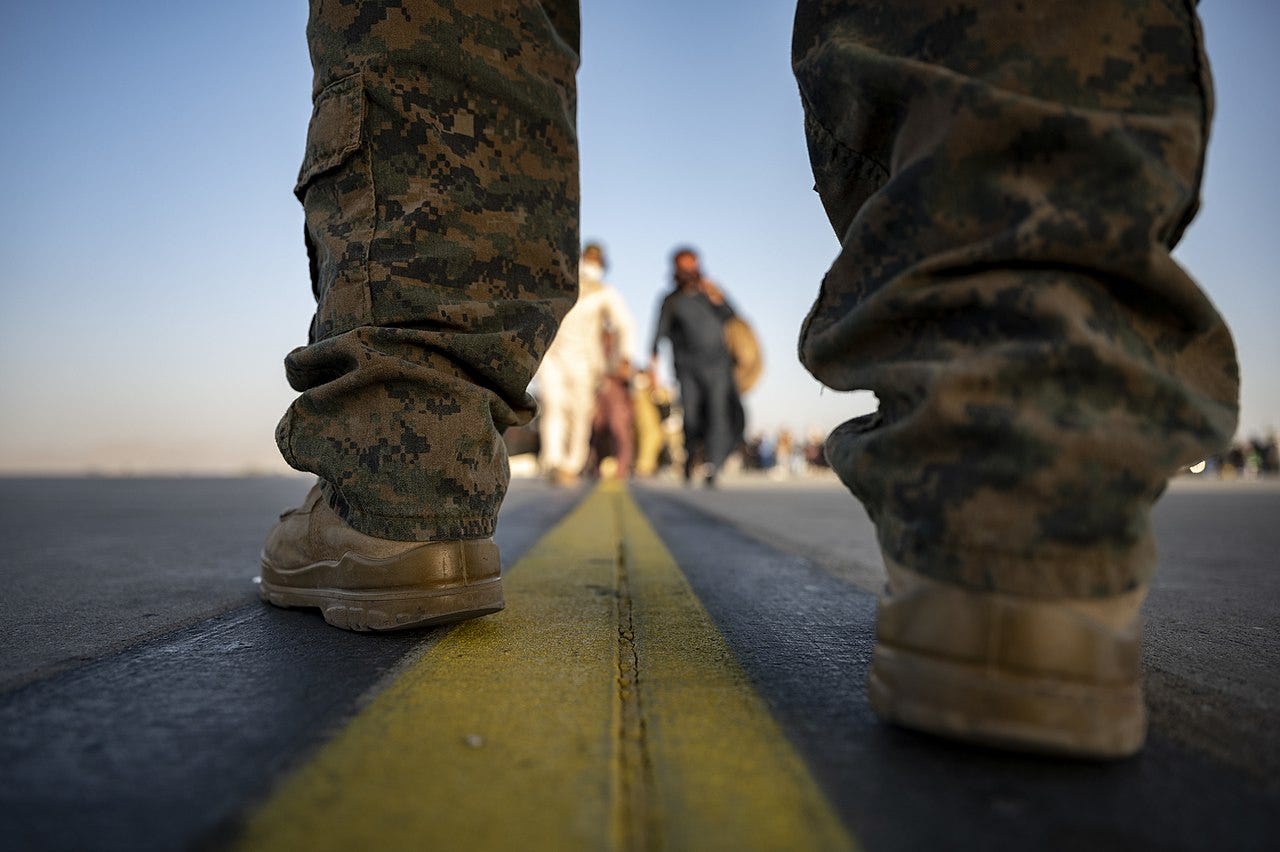
The heart-wrenching images of the chaotic withdrawal of U.S. forces from Afghanistan in 2021 are forever seared into our memories. The fall to the Taliban of province after province and finally of Kabul itself on August 15, 2021, and the deterioration into pandemonium of the evacuation effort at Hamid Karzai International Airport created scenes not seen since the fall of Saigon in 1975. The video of Afghans chasing and clinging to the last departing C-17 provided the final seal of ignominy on two decades of American failure to completely rout out terror and its foolhardy effort to build a democratic nation in the graveyard of empires.
Left behind were hundreds of thousands of Afghans who served and worked alongside American forces over the course of twenty years, Afghans who hoped and believed in a better future for themselves and their families, especially for their mothers, wives, and daughters. With the disappearance over the horizon of the last American military aircraft, those dreams evaporated, replaced by panic and fear. Publicly allying themselves with American forces put them and their loved ones at deadly risk of reprisal from the Taliban. Only a fraction of those Afghans who served and protected American personnel over the course of two decades were evacuated in the mad scramble from Kabul in 2021.
To address this need, the Biden Administration launched Operation Allies Welcome, which utilized the parole process to resettle roughly 86,000 Afghans to the U.S. In 2022, a second phase of that assistance dubbed Operation Enduring Welcome shifted the effort by utilizing existing immigration pathways to resettle immediate family members of U.S. citizens, legal permanent residents and evacuees, those who qualify for a Special Immigrant Visa (SIV) because of their material assistance to U.S. forces, and eligible refugee program applicants. NGO #AfghanEvac reports that more than 195,000 Afghans have been resettled in the U.S. since Summer 2021 through these programs. In December 2024, the Coordinator for Afghan Relocation Efforts (CARE) was formally established in legislation with broad bipartisan support as part of the FY2025 National Defense Authorization Act, which provided authorization for Operation Enduring Welcome through December 2027. This important milestone was key; #AfghanEvac reports that over 200,000 Afghans remain in the pipeline, including more than 3,000 family members of active-duty U.S. military personnel; thousands of Afghans who have already cleared vetting and are awaiting relocation; and over 200 U.S. citizens trapped in Afghanistan. Much work remains to be done.
The current U.S. Administration has repeatedly and harshly condemned the manner in which the previous Administration exited Afghanistan – and justifiably so. Given that criticism, it was logical to assume that it would address that failure with strong leadership and a renewed commitment to keeping the promises we made to Afghans and their families who sacrificed so much – at times even making the ultimate sacrifice. Instead, as a consequence of three broad executive orders issued in recent months, Afghan relocation has been brought to a grinding halt (EO 14163, EO 14169, EO 14161). The Refugee Admissions Program has been paused. Resettlement agencies in the U.S. providing critical support services to newly-arrived SIV holders and refugees have been defunded. If there was any question as to whether the impact on CARE and the Enduring Welcome program was deliberate or unintentional, on May 29 this Administration submitted a congressional notification that it intends to shut down CARE and the entire relocation effort. The White House subsequently submitted its Technical Supplement to the FY2026 Budget informing that it intends to “shut down the Enduring Welcome program by the end of FY2025.”
The Administration’s alleged concern about the entry of Afghan allies into the U.S. ostensibly centers on the inability to properly vet them. The facts, however, are these: having occupied Afghanistan for the better part of two decades, the U.S. has more information on Afghans than on nationals of most other countries. Having worked for and with us, they have been repeatedly vetted, screened, and in many cases polygraphed. As SIV and refugee applicants, they undergo an interagency screening that vastly exceeds that performed on the average visa applicant. No case is relocated in which there is any indication that approval is unlikely, demonstrating a zeal in protecting American borders and prudence in the expenditure of American tax dollars.
Make no mistake: this is a shameful, shocking betrayal and reckless abandonment of our allies and partners. It is not only a cynical renege on the debt we owe to Afghans who aided us and trusted our word; it endangers servicemen and women in future conflicts. Who in their right mind would aid U.S. forces in a future operation, having watched us leave our Afghan allies at the mercy of the Taliban?
Steady State strongly urges the Trump Administration and Congress to recommit themselves to honoring our commitments to those who risked their lives for us. Abandon the plan to shutter CARE; restore funding to the Enduring Welcome program; authorize additional SIV numbers as needed; permit Afghans who qualify to enter the U.S. as refugees; and protect America’s reputation as a reliable, an ethical, a trustworthy friend and ally to all those who support freedom and democracy, particularly those who stand shoulder to shoulder with us at great personal sacrifice.
Initially founded in 2016, The Steady State is a nonpartisan, nonprofit 501(c)(4) organization of more than 270 former senior national security professionals. Our membership includes former officials from the CIA, FBI, Department of State, Department of Defense and Department of Homeland Security. Drawing on deep expertise across national security disciplines including intelligence, diplomacy, military affairs and law, we advocate for constitutional democracy, the rule of law and the preservation of America’s national security institutions.