
National Security for the Dinner Table- The Real Cost of Losing Taiwan
The Steady State | Sergio Fontanez

Welcome to “National Security for the Dinner Table,” The Steady State’s new series that aims to break down complex national security issues with direct implications for our lives and wellbeing into clear, relevant facts and observations to assist American individuals and families in formulating opinions and decisions.
Following the Administration’s high-level visit by a Taiwanese delegation last week, we begin with a timely and important question: Why should Taiwan matter to American families? This first installment explains how events unfolding thousands of miles away could impact everything from consumer goods and retirement accounts to elder care and job security here at home.
What Is Taiwan and Where Is It Located?
Taiwan is a democratic island nation of over 23 million people located off the southeastern coast of China, about 100 miles across the Taiwan Strait. Though it has its own government, military, and vibrant civil society, the People’s Republic of China (PRC) claims Taiwan as a province, even though Taiwan has never been ruled by the PRC.
Taiwan ranks among the world’s most advanced economies and is a global leader in high-tech manufacturing, especially semiconductors, the “brains” that power everything from smartphones to missile systems.
Why Does China Care So Much About Taiwan?
For the Chinese Communist Party (CCP), the political party that runs the PRC, Taiwan represents more than a territorial dispute. It is a symbol of an unfinished civil war and an ideological challenge. Taiwan’s thriving democracy, right next door, contrasts sharply with China’s one-party rule.
PRC leadership sees reunification as essential to its national pride, political legitimacy, and long-term strategic control of the Western Pacific. Gaining control of Taiwan would also give the PRC dominance over one of the most important trade and technology nodes in the global economy.
Why Does the United States Care So Much About Taiwan?
Taiwan is located in a very important spot in the Pacific Ocean, near countries like Japan and the Philippines. This location helps the U.S. military keep the peace in the region and protect our allies. If China were to gain control of Taiwan, it could weaken U.S. and allied security, intimidate key international partners, and disrupt maritime shipping lanes in which the U.S. relies. Additionally, allowing a free country like Taiwan to be controlled by a one-party dictatorship would encourage other totalitarian governments to consider aggression against smaller democracies–leading to more conflicts in places like the South China Sea or even Europe.
Beyond U.S. Strategy: Why Should Americans Care about Taiwan Sovereignty?
Retirement Will Have to Wait: If the PRC gains control of Taiwan, it could cause a big drop in the stock market, especially in tech companies that many retirement accounts depend on. According to Endeavor Capital Management, a financial services firm in Chicago, explicitly defined technology companies make up approximately 40% of the S&P 500, all of which have Taiwan exposure. Meanwhile, “implicit” companies, businesses categorized under other sectors but still reliant on similar advanced technologies, make up nearly 100%.
That means the money that people are counting on for retirement could lose significant value. For example, a stock-heavy 401(k) could decrease by 30% to 50%. Even more balanced stock-bond accounts could lose 15% to 30%, and safer, bond-focused ones might still drop up to 10%. For many people, this could mean a significant reduction in spending and putting off retirement for up to a decade. In short, if Taiwan falls, a lot of Americans might have to delay their plans.
Healthcare of Seniors and the Vulnerable Will Be At Risk: If Taiwan were to fall under control of the Chinese government, the elderly and the vulnerable will be directly affected. How? Because medical equipment particular to their needs would face serious disruptions. Many medical devices, such as glucose monitors, pacemakers, electric hospital beds, and CPAP/BiPAP Machines would see increased costs and decreased availability. (Think COVID era PPE shortages compounded.)
On top of that, the retirement savings losses discussed that so many seniors rely on will make it harder to afford assisted living or in-home services, especially at what would become increased costs. With telehealth tools and senior monitoring systems also at risk due to chip shortages, families across the country could find themselves caring for aging parents without the tools or support they have come to depend on.
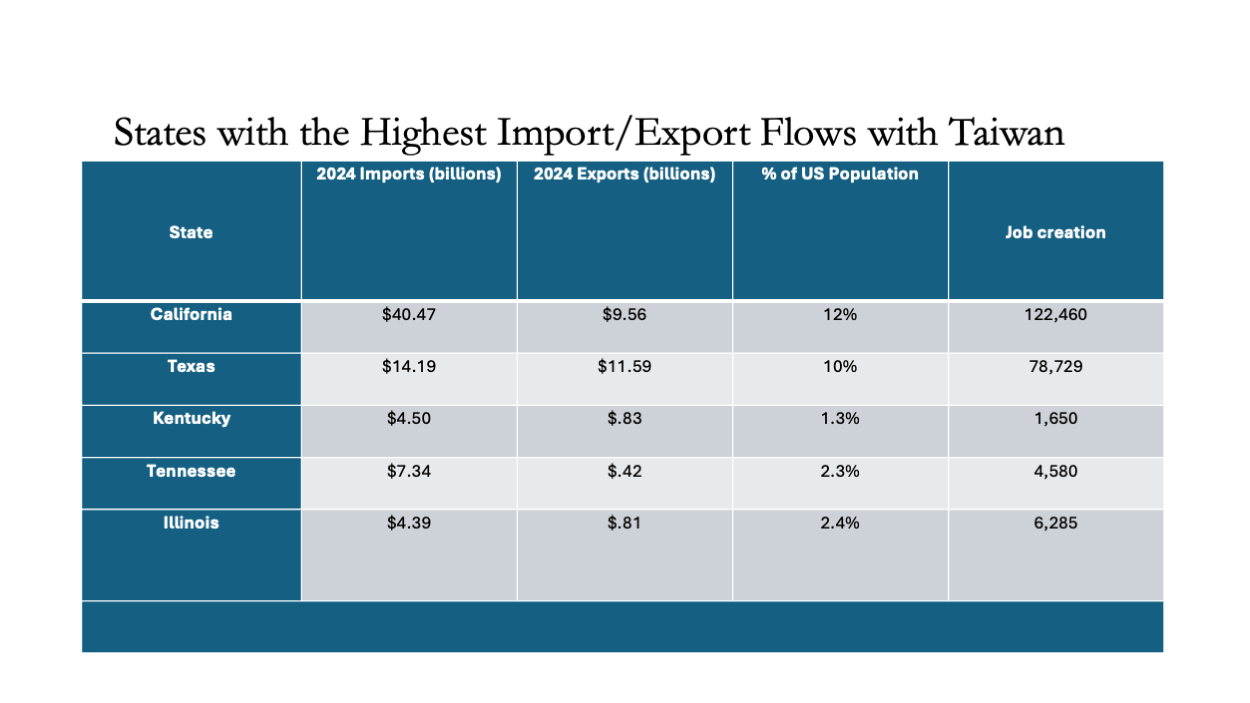
Jobs, Jobs, Jobs: If Taiwan were to fall under control of the PRC, the impact on American jobs, especially in states with strong trade ties, could be severe. California, which handles over $50 billion in trade with Taiwan and represents about 12% of the U.S. population, could see more than 122,000 jobs at risk, particularly in high-tech, logistics, and export industries. Texas, with nearly $26 billion in trade and 10% of the population, supports around 78,700 jobs tied directly to trade and investment with Taiwan.
*Pulled from International Trade Administration Data
Conclusion: Diplomatic engagement and the allied support of Taiwan are a priority to avoid conflict and maintain stability. As a key democratic partner and the world’s leading producer of advanced semiconductors, products made in Taiwan help power everything from smartphones and cars to medical devices and military systems. Taiwan under PRC control could trigger major supply chain disruptions, raising prices on everyday goods, delaying retirement by shrinking 401(k)s, and making eldercare more expensive and less accessible, among other things. This is only a slice of the potential impact U.S. foreign policy on Taiwan could have on American families.
Sergio Fontanez is a U.S. Air Force veteran and deployed to Afghanistan in support of Operation Enduring Freedom. Sergio also served as an Intelligence Analyst in the U.S. Department of State and most recently served as National Security Advisor to the U.S. Export-Import Bank. He is a member of The Steady State
Founded in 2016, The Steady State is a nonpartisan, nonprofit 501(c)(4) organization of more than 300 former senior national security professionals. Our membership includes former officials from the CIA, FBI, Department of State, Department of Defense and Department of Homeland Security. Drawing on deep expertise across national security disciplines including intelligence, diplomacy, military affairs and law, we advocate for constitutional democracy, the rule of law and the preservation of America’s national security institutions.