
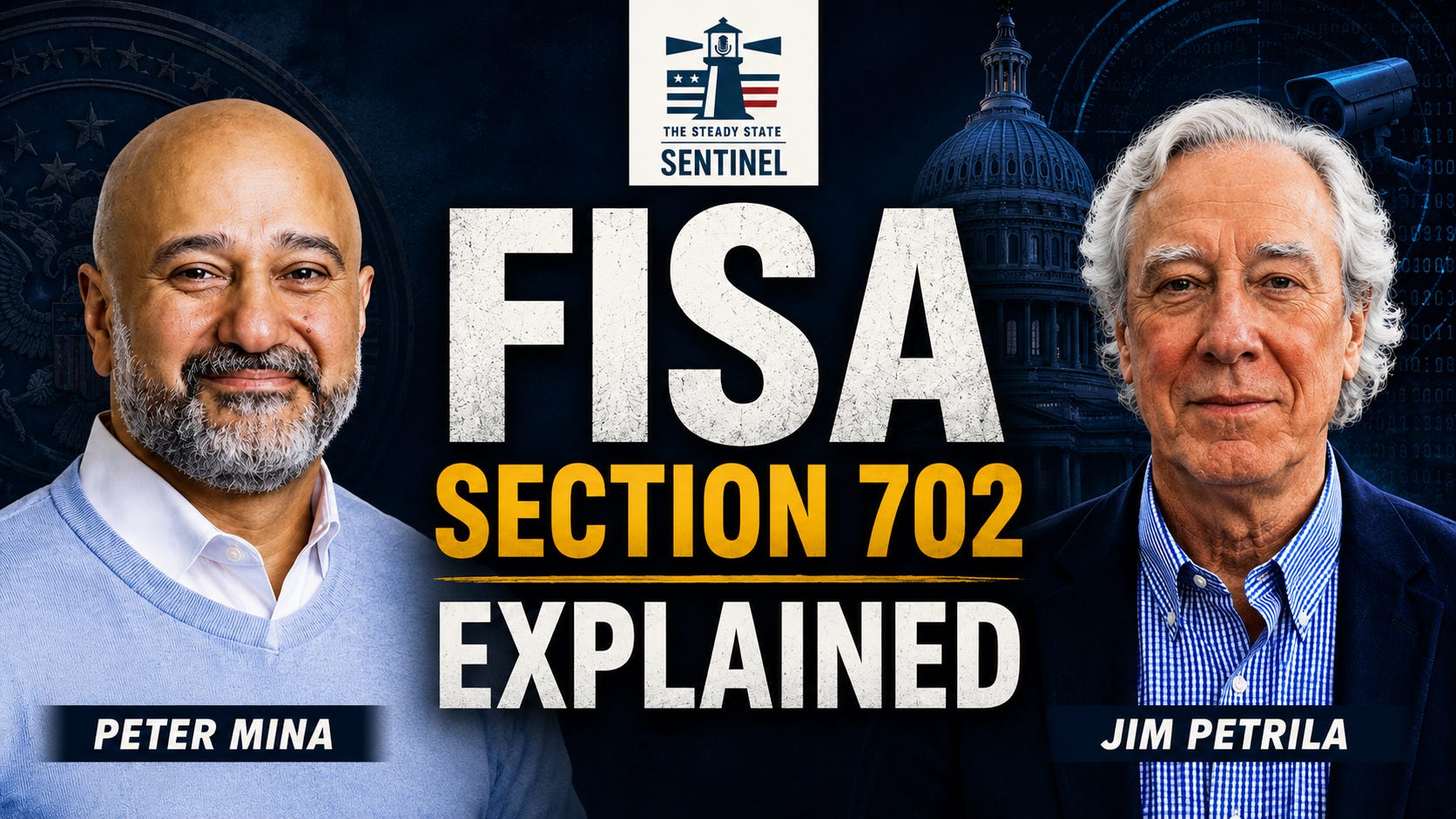
Former CIA Senior Officer Jim Petrila joins Peter Mina to break down the evolution of the Foreign Intelligence Surveillance Act (FISA), the controversies surrounding Section 702, and the growing tension between national security surveillance and civil liberties. Petrila explains how technological shifts after the Cold War and 9/11 transformed intelligence collection, leading to major legal and policy battles over government access to communications data.
The conversation explores incidental collection of Americans’ communications, debate over the need to obtain warrants, oversight concerns, and the expanding role of third-party data brokers that collect and sell personal information outside many traditional safeguards. Petrila also warns how surveillance authorities and emergency powers can become vulnerable to abuse when accountability and public trust erode.
Watch and listen to new Sentinel episodes each Tuesday. Subscribe and review us on your favorite podcast platform.
About the guest: James Petrila spent over thirty years as a lawyer in the Intelligence Community, working at the National Security Agency and, for most of his career, at the Central Intelligence Agency with the Office of the General Counsel. He has taught courses on counterterrorism law and legal issues at the CIA at the George Washington University School of Law. He is currently a senior advisor to the Institute for the Study of States of Exception and is a member of The Steady State.
Founded in 2016, The Steady State is a nonprofit 501(c)(4) organization of more than 400 former senior national security professionals. Our membership includes former officials from the CIA, FBI, Department of State, Department of Defense, and Department of Homeland Security. Drawing on deep expertise across national security disciplines, including intelligence, diplomacy, military affairs, and law, we advocate for constitutional democracy, the rule of law, and the preservation of America’s national security institutions.