
Standing Together, Disagreeing Later: The Logic of the “Strange Bedfellows” Strategy
The Steady State | February 17, 2026

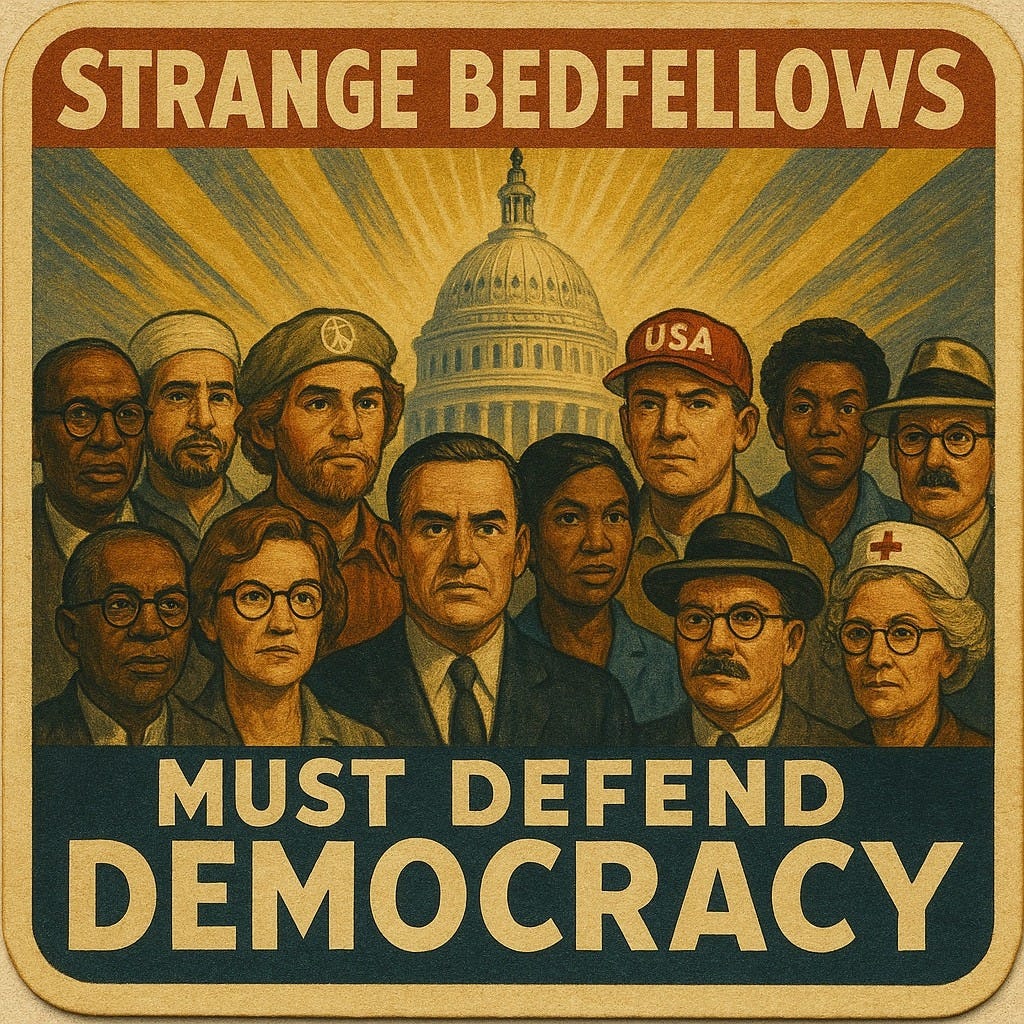
The Steady State often speaks of the need for what we have come to call “Strange Bedfellows.” The phrase is intentionally plainspoken. It describes a simple but powerful idea: that the preservation of democratic institutions depends on coalitions that cut across policy preferences, demographics, geography, profession, culture, and even long-standing political disagreements. In ordinary times, many of these alliances would feel unnatural. In some cases, they would not exist at all. But history, and the lived experience of our members, shows that when democratic systems come under sustained pressure, such coalitions are not merely useful. They are essential.
The Steady State is comprised of former senior national security, intelligence, diplomatic, military, and law enforcement professionals who have spent careers overseas, studying how democratic societies weaken and how authoritarian systems consolidate power. Our members have observed, up close and over decades, both the collapse of fragile democracies and successful resistance to autocracy in others. Across regions and eras, one lesson stands out with striking consistency: resistance to authoritarianism succeeds when it is inclusive and appeals to the broadest swath of the population. It succeeds when people who disagree on many things agree on the things that matters most.
In normal political life, divisions are natural and healthy. Citizens argue over taxes, regulation, foreign policy, education, social questions, and the appropriate size and scope of government. These debates are the lifeblood of a functioning democracy. They create friction, and sometimes deep frustration, but they occur within a shared framework of rules and expectations. Political opponents remain fellow citizens. Institutions remain legitimate. Elections settle disputes. Courts adjudicate conflicts. The system, though imperfect, holds.
Authoritarian movements seek to erode that shared framework. They do not begin by eliminating disagreement; they begin by turning disagreement into division, and division into isolation. They target institutions, stigmatize dissent, and encourage the belief that only certain voices are legitimate. Over time, this isolates groups from one another, making collective action more difficult. People retreat into their own camps, their own media ecosystems, their own communities, and their own grievances. In that environment, resistance fragments.
This is where “Strange Bedfellows” becomes necessary.
When democracy as a governing principle begins to weaken, the usual divisions must be bridged. People who have spent years arguing with one another on policy grounds must recognize a shared interest in protecting the underlying system that makes those arguments possible. Business leaders and labor organizers. Civil libertarians and law-and-order advocates. Conservatives, moderates, and progressives. Urban and rural communities. Secular groups and faith communities. National security professionals and privacy advocates. In another time, many of these groups might be adversaries. In a moment of democratic stress, they must become partners. The must march together.
Our members have seen this pattern repeatedly in other countries. The successful resistance movements are rarely ideologically pure. They are often awkward. They involve individuals and organizations that do not fully trust one another, and that may return to open disagreement once the immediate threat passes. The alliances are sometimes fragile and often uncomfortable. But they are broad. And their breadth is their strength.
Authoritarians benefit when opposition is narrow. A movement that is easily labeled, easily dismissed, or easily caricatured can be isolated and ignored. However, when resistance spans professions, regions, parties, and communities, it becomes far harder to marginalize. When people who do not ordinarily stand together choose to do so, it sends a signal that the issue at stake transcends ordinary politics.
That is the core of the Strange Bedfellows concept. It is not about abandoning deeply held views. It is not about asking people to mute their identities or convictions. It is about recognizing that there are moments when the preservation of democratic norms becomes the prerequisite for all other debates. If the system that protects speech, elections, courts, and lawful dissent erodes, then every policy dispute becomes secondary. The space for disagreement itself begins to shrink.
These coalitions are, by definition, imperfect. They require patience. They require restraint. They require a willingness to stand alongside people who may see the world very differently. They also require clarity about purpose. The goal is not to produce a unified political agenda. The goal is to protect the constitutional and institutional framework within which competing agendas can be pursued peacefully and lawfully.
The Steady State has been forward-leaning in embracing this approach because our members have seen, firsthand, how isolating forces can be. We have also seen how powerful it is when those forces are countered by broad, visible cooperation. The Strange Bedfellows concept is not a slogan. It is an observation drawn from experience. It reflects the reality that durable resistance to authoritarian tendencies is not built on uniformity. It is built on breadth.
In ordinary times, some of these alliances would seem unlikely, even undesirable. In extraordinary times, they may be the only thing that works.
Founded in 2016, The Steady State is a nonprofit 501(c)(4) organization of more than 390 former senior national security professionals. Our membership includes former officials from the CIA, FBI, Department of State, Department of Defense and Department of Homeland Security. Drawing on deep expertise across national security disciplines including intelligence, diplomacy, military affairs and law, we advocate for constitutional democracy, the rule of law, and the preservation of America’s national security institutions.
Well-said: Reasonable people can disagree about this-or-that policy issue --- but now is the time to come together to preserve our essential core freedoms.
Couldn't be more true. Believe me, no one was more surprised than I when I realized the Liz Cheney and I agreed. Some things REQUIRE agreement for democracies to exist.