
The Intelligence Community Has a Consumer Problem
America’s spies can collect the truth, analyze the risks, and warn of the consequences. But they cannot force a president to listen.


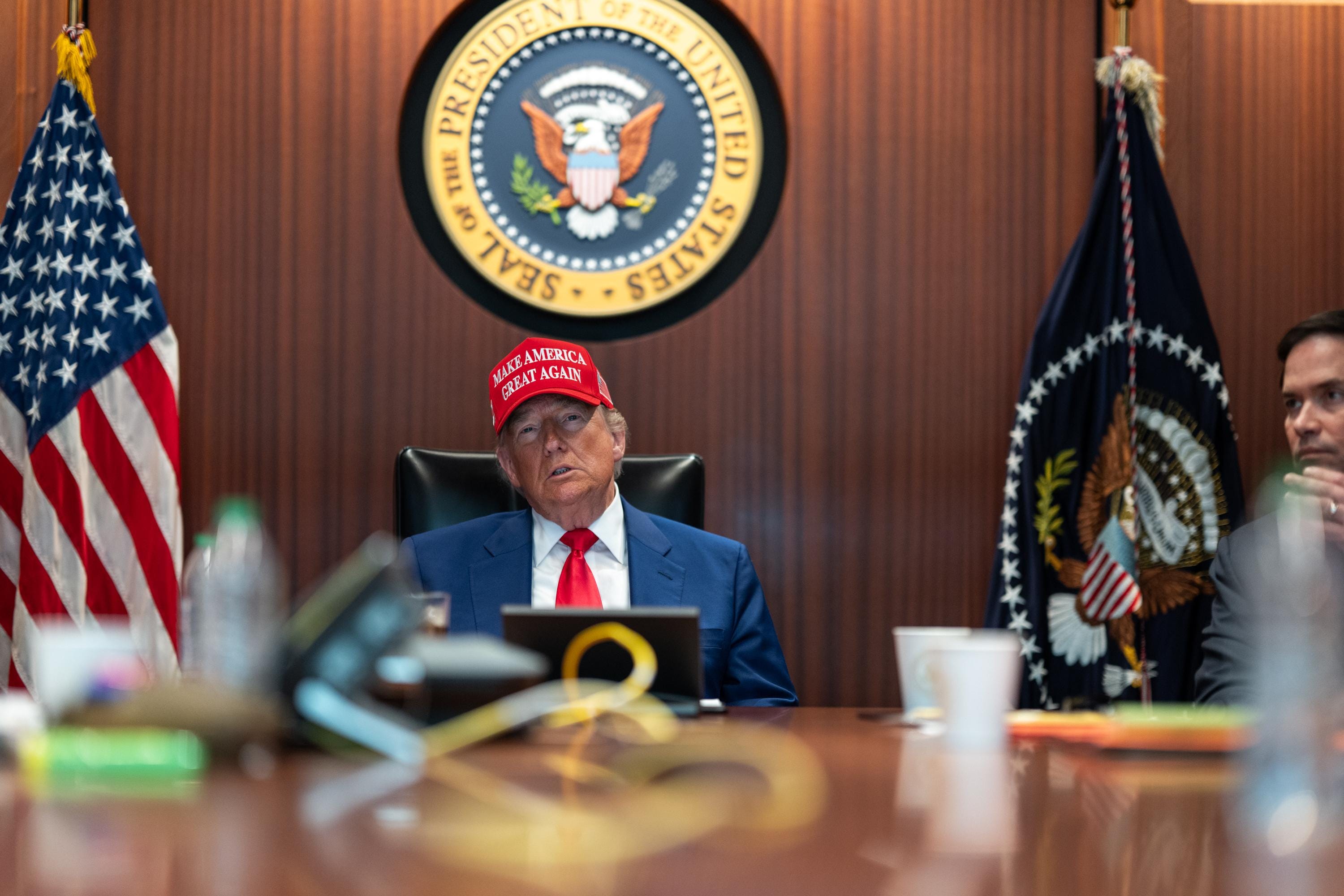
President Trump in the Situation Room
Bill Pulte’s failed nomination and Jay Clayton’s selection are not the story. They are symptoms of a deeper problem—a president who appears to place greater faith in personal instinct than professional intelligence. When policymakers stop listening, even the best intelligence in the world becomes irrelevant.
The outcry over the now-withdrawn appointment of Bill Pulte to the position of (Acting) DNI, the Director of National Intelligence, misses the point. Both Pulte and the more recently announced Jay Clayton lack any intelligence experience or expertise in managing a sprawling 18-member organization such as the Intelligence Community (IC). The debate regarding the selection of either of these two has distracted from the far more deep-seeded problems within this Administration: The President’s utter disdain for the work of the IC and his supremely inflated confidence in his own sense of judgment.
Let’s be clear up front about how our Intelligence Community system is designed to work:
The Intelligence Community (IC) informs policy.
The President and other government officials who are consumers of intelligence make policy. Full stop!
It is important to repeat here the nature of intelligence collection and what role it plays in policymaking. In a nutshell, as a CIA operations officer, I gathered “raw intelligence” from human assets, or agents. Raw intelligence is sensitive information collected by officers such as myself, as well as those who collect information from technical/electronic sources. The various pieces of intelligence are then synthesized by expert analysts and presented to the consumer/policy maker as “finished intelligence.” This may range from a short blurb of new information to a full intelligence estimate on a policy issue from the entire community. Such estimates may include a forecast of likely events and a range of proposed options to consider, weighted to account for levels of confidence in the sources of the raw intelligence and analytical conclusions. All are for the purpose of providing the consumer with relevant information pertinent to their decision-making.
This presupposes that the policymaker is willing to read or listen to and, more importantly, “hear,” a verbal briefing. But in the end, the President does not need to listen to or consider what he or she is told. It is the President’s call. A judgment call.
When a Consumer Refuses to Listen
It is unclear how or when President Trump receives his intelligence briefings. But it is entirely clear that he does not value what they are telling him. He is the one who makes policy. And that power requires…judgement. And here lies the rub: The President’s judgment is, to be kind, faulty. It has most recently landed us in a no-win situation vis-à-vis Iran, and it is evident in other decisions:
Tariffs: The IC, along with other departments such as Commerce and Treasury, would have been able to advise the President of the likely reception and responses, country by country, to his imposition of the broad tariff regime he instituted early in his administration. Those departments no doubt predicted and could have warned us, about the negative effects we have seen and continue to see, on the US (and world?) economy. There is no evidence that the President even asked.
China: China is one of the most important trading partners and a geopolitical rival of the United States. The IC would have been able to provide a thorough, balanced analysis, based on facts and painstakingly collected sensitive intelligence rather than his gut feeling, on the likely response by China: embargoing the availability of rare earth materials that are critical to America. He either failed to ask or dismissed their conclusions and was, in part as a result, reduced to a virtual supplicant to Xi during the recent U.S./Chinese summit.
Iran: The President reportedly ignored explicit warnings that one of Iran’s first moves would almost certainly be to close the Strait of Hormuz. He dismissed this and claimed, without evidence, that the regime would “collapse” before then. This was a judgment call. Doubtless, he was also told, or would have had he asked, that Iran would look to strike our Gulf allies in retaliation. Dismissing this was another judgment call. We are now mired in a conflict from which there is no easy exit, and which threatens to result in strategic defeat.
In each of these cases, President Trump would have received, if he had asked, the IC’s best assessment of the plans and intentions, as well as the range of possible responses to these critical economic and security-related events. If he did, he appears to have ignored it. In all, he chose to “go with his gut,” and we find ourselves in a position where we have literally empowered adversaries at the expense of America.
The IC Isn’t Perfect
The IC does not always get it right: I was the No. 2 CIA officer for Iraq the summer of 2003, immediately following the conclusion of major combat operations. The CIA got it wrong on WMD. But Policymakers who choose to ignore the IC do so at their peril: in 2003, leadership compounded the CIA’s mistake by discounting intelligence that indicated the difficult road ahead, resulting in overconfidence, poor planning, and lack of vision.
As for the leadership of the DNI, whether Tulsi Gabbard, Pulte, Clayton, or another unqualified supporter of the President, it is becoming increasingly irrelevant. Whoever eventually assumes the role, we have a President who values his own “gut instincts,” alone.

Mark Fowler is a decorated CIA Senior Operations Officer. Retired 22 years of service, he is a middle east expert, a veteran of the War on Terror, Iran specialist and served in foreign assignments across Europe, South Asia. He is a first-time author of, soon to be published, A PRINCE OF MIRRORS (A CIA Odyssey of Trust and Betrayal), and is currently working on his second novel, SECOND PROTOCOL. He is a member of The Steady State.
Founded in 2016, The Steady State is a nonprofit 501(c)(4) organization of more than 400 former senior national security professionals. Our membership includes former officials from the CIA, FBI, Department of State, Department of Defense, and Department of Homeland Security. Drawing on deep expertise across national security disciplines, including intelligence, diplomacy, military affairs, and law, we advocate for constitutional democracy, the rule of law, and the preservation of America’s national security institutions.
 | A guest post by
|
Wise words, supported by considerable experience. The line that stood out the most to me pointed to the root of the problem: President Trump's "utter disdain for the work" of U.S. intelligence, and "his supremely inflated confidence in his own sense of judgment." Another way to put that: The president of the United States is basically a blowhard who lacks the necessary intellect and emotional maturity that his job requires.
Thanks, Greg. I remember that! It was outrageous. But, unfortunately, true to form. Both uninformed and unbecoming of the office!