
The International Rules-Based Order is NOT “Cloud Castle Thinking”
The Steady State | by Harry Hannah

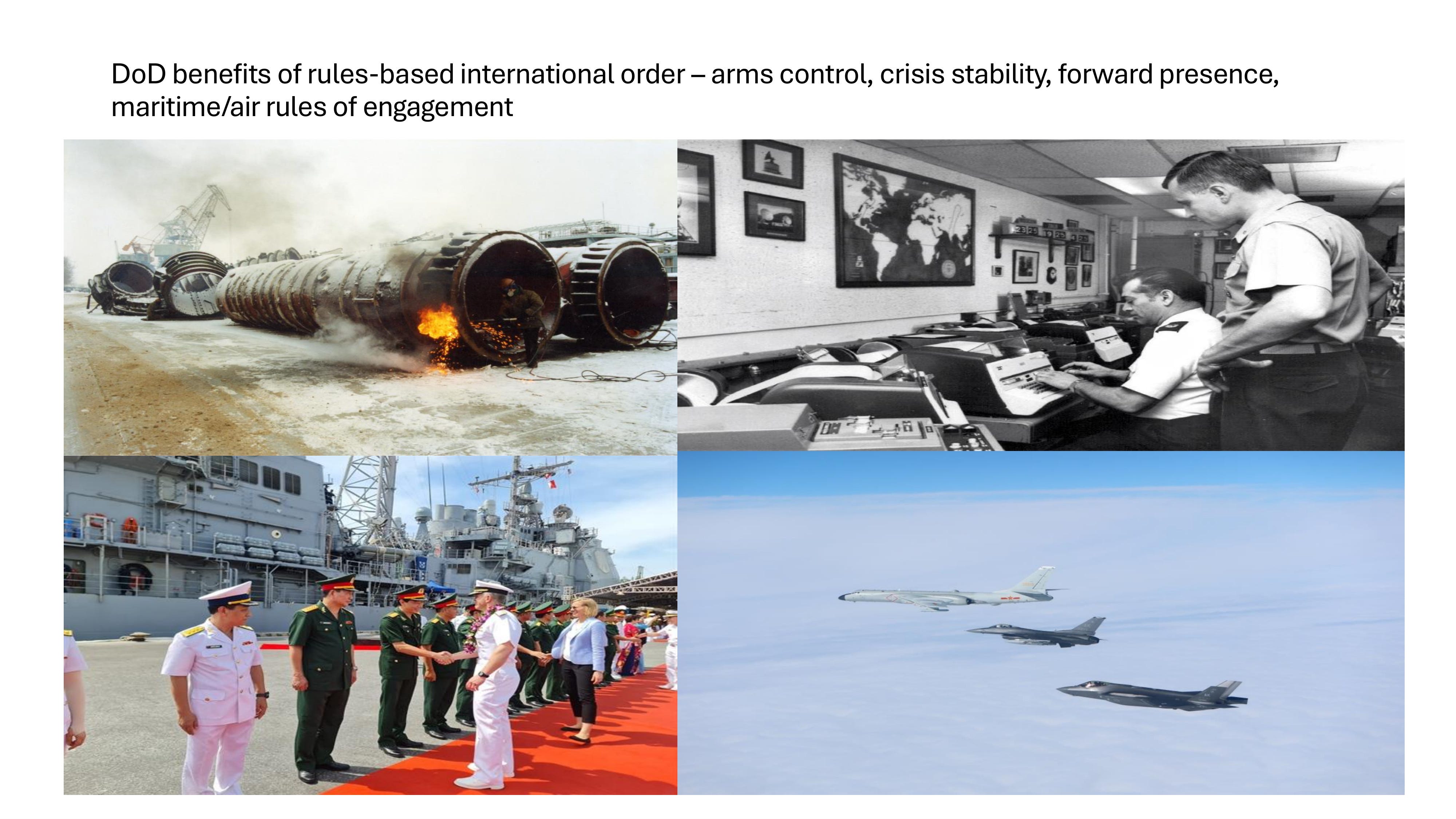
Defense Secretary Hegseth’s introductory letter to the National Defense Strategy (NDS) dismisses all past administrations, Republican and Democratic alike, for pursuing what he calls, but does not define, “cloud castle thinking” by supporting the “rules-based international order.” This is a shallow, ideologically driven misreading. The rules-based international order is not a fantasy; it is a practical asset to the US military. It reduces threats by limiting certain forms of military rivalry, regularizes interaction among the world’s armed forces, establishes standards to avoid accidents and unintended escalation, and provides a legal framework for managing ambiguous disputes. Notably, the NDS’s main text does not echo Hegseth’s dismissal, perhaps reflecting wiser thinking within DoD.
What the Rules-Based International Order Actually Is
Hegseth never defines what he means by the terms he derides. A working definition of the rules-based international order could be: a web of formal and informal laws, rules, agreements, procedures, and norms that regularize relations among nearly 200 countries and the multilateral institutions that manage those relationships in an increasingly interconnected world. While this order is heavily focused on non-military matters, it has critical elements that directly address the security challenges the US military faces every day.
Arms Control and Non-Proliferation
Arms control has been a central feature of the rules based international order since WWII as the world wrestled with how to manage the unparalleled destructive power of modern weapons. For 80 years, the US has pursued arms control, especially involving nuclear weapons, to limit the threats facing America and its allies. Without the negotiated agreements, the US military confronts a larger, more capable adversary threat environment. Some of these agreements are largely bilateral between the US and Soviet Union/Russia, while others were multilateral, directly impacting US allies. Regardless, they are embedded in a widely accepted international system of formal/informal rules and norms.
The multilateral Nuclear Non-Proliferation Treaty (NPT) is the cornerstone of US efforts to limit the number of nuclear-armed states. It also affects civil nuclear trade affecting US industry, and, along with the International Atomic Energy Agency (IAEA), is essential to countering emerging threats like Iran. Any future US-Iran monitoring will be built on the NPT framework and require IAEA involvement.
There is also a critical linkage at work: other countries forego nuclear ambitions in part based on great-power commitments to limit their own arsenals. Beyond the NPT, agreements restricting chemical and biological weapons, missile development, and arms transfers, all embedded as a part of the rules-based international order, further reduce the threat environment the US military must navigate.
Worldwide Military Interactions
US military power depends on a large global presence; permanently based forces, training and exercises, security assistance, arms sales, ship visits, aircraft transits, and combat operations. All of this is underpinned by a set of international laws, rules, and norms that allow the US to operate routinely. This is the mundane but essential day-to-day business of the US military; something Hegseth, given his lack of experience, does not appreciate. While there always will be a bilateral dimension, these relationships are based upon a widely endorsed foundation within the “international rules-based order”. Many of these arrangements are also tied to multilateral institutions, including within the UN system.
Avoiding Accidents and Unintended Escalation
Given the global scope of US military operations, accidents and incidents with potentially hostile states are inevitable. Preventing escalation through established rules is therefore essential. The US-Soviet “Incidents at Sea” (INCSEA) agreement, established in the early 1970s, is a model: it allowed the US to conduct critical missions while managing the risk of escalation. The US has sought a comparable arrangement with China, with limited success, highlighting the importance of these types of agreements.
Hotlines and crisis communication centers, including the US-Soviet/Russian hotline and Nuclear Risk Reduction Center, represent another layer of this architecture. These efforts have spawned a web of broadly similar arrangements among a variety of countries. For example, the US facilitated a hotline between the Indian and Pakistani militaries, which has proven essential in de-escalating multiple potential nuclear crises. All of these arrangements rest on a broader foundation of globally shared norms, the very order Hegseth dismisses.
Ambiguous Areas of Dispute
US naval and air forces are indispensable to American military power, but their ability to operate globally depends on more than technological superiority. It depends on the internationally agreed array of maritime and aviation laws, rules, and procedures governing use of the seas and airspace. Without this foundation the US military would be more dependent on sheer force and pressure to operate globally adding diplomatic hurdles and increasing operational challenges and risks..
Nowhere is this more consequential than in the South China Sea (SCS) and East China Sea (ECS), where the US has backed regional allies in resisting Chinese territorial aggression. Part of China’s strategy has been to redefine the relevant laws and norms to justify its actions. Hegseth’s contempt for the rules-based order plays directly into Beijing’s hands and directly undermines the NDS’s own stated focus on defending the First Island Chain against China. He is working against his own strategy.
More troubling still are the administration’s so-called counter-drug interdiction operations in the Caribbean and eastern Pacific, which rest on a dubious legal foundation at best. Chinese strategists and lawyers are almost certainly monitoring these actions for ways to exploit them in their own legal and public diplomacy campaigns in the SCS and ECS.
The US Military Benefits from the International Rules-Based Order
Hegseth and those who share his worldview want American military power unconstrained, used purely to compel acceptance of US policies. But the rules-based international order does not constrain US military capability; it enhances it. Every administration for the past 80 years, Republican and Democratic, has understood this. Abandoning that foundation does not make America stronger. It makes the task of the US military harder, the threat environment more dangerous, and the risks of escalation higher, while handing strategic advantage to adversaries, above all China, who are watching carefully and taking notes.
Harry Hannah retired after four decades of experience in the Intelligence Community. He retired from the CIA in 2018. About half that time was focused on analyzing the capability of multiple foreign militaries in direct support of US military planning and operations and national level decision making. He is a member of The Steady State.
All statements of fact, opinion, or analysis expressed are those of the author and do not reflect the official positions or views of the US Government. Nothing in the contents should be construed as asserting or implying US Government authentication of information or endorsement of the author’s views.
Founded in 2016, The Steady State is a nonprofit 501(c)(4) organization of more than 390 former senior national security professionals. Our membership includes former officials from the CIA, FBI, Department of State, Department of Defense, and Department of Homeland Security. Drawing on deep expertise across national security disciplines, including intelligence, diplomacy, military affairs, and law, we advocate for constitutional democracy, the rule of law, and the preservation of America’s national security institutions.
Thank you.
Years of serious study and experience went into this essay (as opposed to the towel-snapping currently going on in the Pentagon's E Ring.) Wise Secretaries of Defense listen to such non-partisan authorities.