
The "Long Con" - Trump’s Billion Dollar Ballroom
How Trump turned a vanity project into a taxpayer-funded “security necessity”


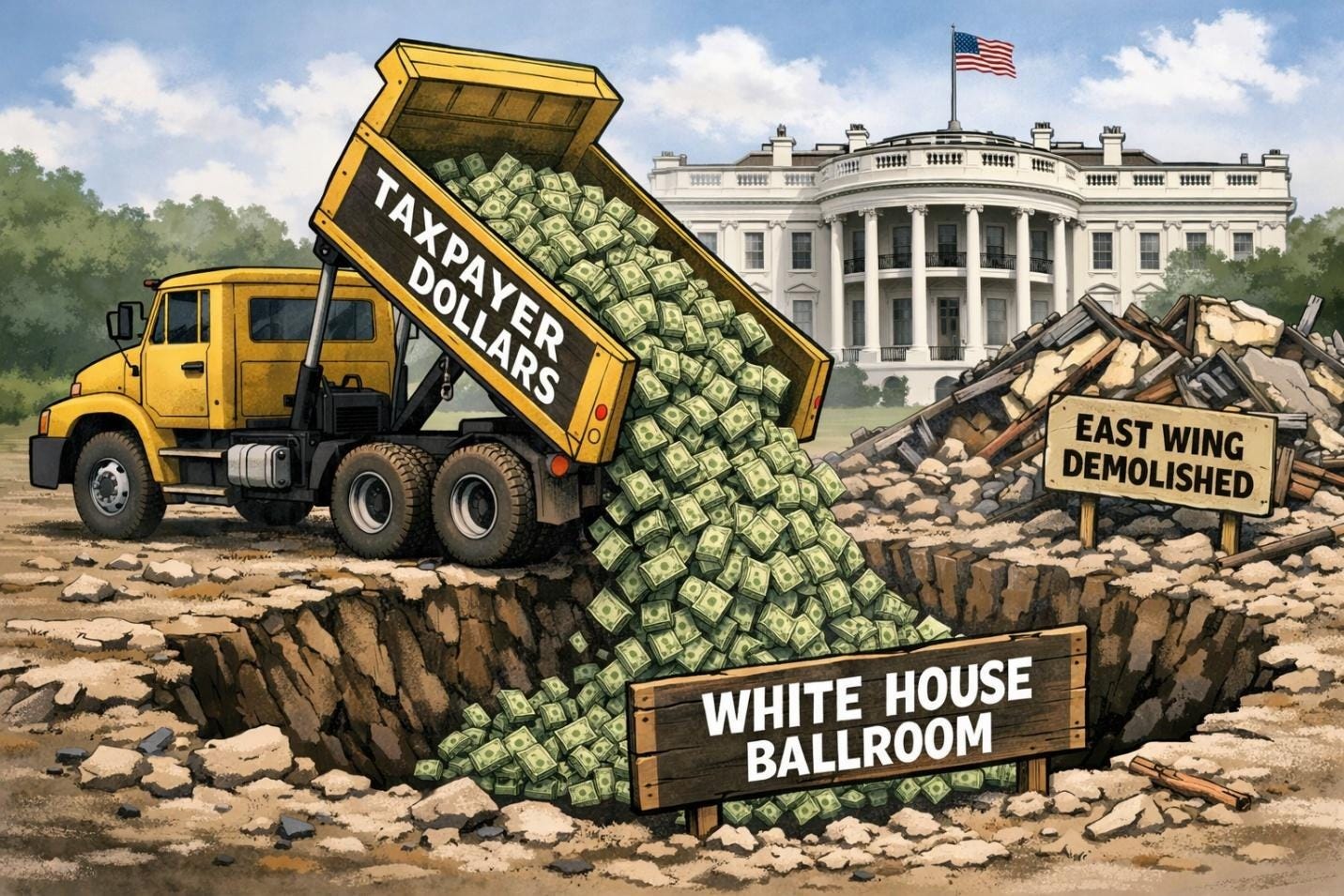
Trump’s East Wing ballroom may become the ultimate political “long con” —a project sold as privately financed that gradually conditions the public to accept ever-expanding taxpayer commitments as inevitable and necessary.
When Donald Trump was inaugurated in January 2025, he kicked off with a barrage of executive orders, ‘flooding the zone’ with more than the normal human mind can process effectively, and he hasn’t let up since. So many things have happened, keeping track, and assessing the damage he’s doing to American democracy is a fulltime job. Some of the things he’s done, like starting a war with Iran, attacking Venezuela and kidnapping their president, ordering the destruction of alleged drug smuggling boats in the Caribbean and eastern Pacific—the list goes on—dominate the headlines, causing some of his other misbehavior to have to compete for oxygen in the media biosphere.
One example of the myriad actions he’s thrown against the wall to see if they stick is his much-ballyhooed ballroom which he wants to build on the site of the demolished East Wing of the White House. It gets media now and then, and has even been the subject of a few in-depth analyses. What’s been overlooked, or ignored, is the fact that this project, regardless of the final outcome, is likely to go down in history as the world’s greatest con job, a masterful long con.
Here’s why.
A long con (short for “long confidence game”) is a scam that plays out over time. The mark is slowly conditioned to accept a storyline, small commitments are normalized, and the biggest “ask” comes only after the target has been nudged into believing the outcome is inevitable. In politics, the “mark” is the public, and sometimes even Congress; while the payoff is not just money, but power, precedent, and a new reality that people feel too exhausted to reverse.
Here’s how the long con works.
Start with the pitch. In late July 2025, the White House announced plans for a roughly 90,000-square-foot “event space”/ballroom as part of an “East Wing Modernization Project,” floating an initial estimate of about $200 million and promising it would be paid for by Trump and “patriot donors,” with “not one dollar” coming from taxpayers.
Almost immediately, ethics lawyers and preservation advocates warned that even if private money covered the structure, the federal government would still be on the hook for approvals, operations, maintenance, staffing, and, most importantly, security. There were also concerns by some ethics experts that this project would be an opening for donors to gain favor with this and future administrations.
Then came the familiar creep. By September and October 2025, Trump was publicly revising the price tag upward—first to around $250 million, then to about $300 million—while insisting the financing story had not changed. In the same period, professional organizations pressed for transparency and for the normal historic review process to run its course. Site preparation was underway before those processes were complete, which mattered because once you start ripping things out, “debate” becomes mostly ceremonial.
The decisive move was demolition. Beginning around October 20, 2025, heavy equipment began tearing down the East Wing, and by October 23 the structure had been reduced to rubble—an irreversible act that reframed the argument from “should we do this?” to “how do we finish what’s started?” Trump defended the destruction as necessary for a “beautiful building,” while the White House repeated that private donors would pay. Meanwhile, reporting raised a second-order question: even if a donor pays for walls and chandeliers, who pays for fencing, screening lanes, command posts, blast mitigation, underground work, and the Secret Service footprint that comes with a permanent new mass-gathering venue on the compound?
Through late 2025 into early 2026, the project took on the look of an established “program”: design teams were selected, plans circulated, and federal planning bodies heard waves of public comment. Whatever one thinks of the merits, the direction of travel was clear—construction first, arguments later. By the start of 2026, cranes, barriers, and the language of “modernization” had effectively laundered a vanity addition into the category of routine infrastructure.
In May 2026, the estimate jumped again. Trump acknowledged the price had risen from about $200 million to “something less than $400” million, arguing that “deep rooted studies” had led to a ballroom roughly twice the size and of “far higher quality” than the original concept. That is the classic midpoint of the long con. The mark is told the change is not a change at all, merely an “upgrade” that was “necessary,” decided “long ago,” and somehow still “under budget.”
And then came the big “ask,” dressed up as something else. Senate Republicans began floating ways to put federal money behind the project, including one proposal for $400 million directly and, more consequentially, a much larger proposal that would set aside $1 billion in a budget reconciliation package for Secret Service “security adjustments and upgrades” tied to the East Wing Modernization Project—language that pointed straight at the ballroom site while avoiding the word ballroom. Supporters argued the money would fund only security features, not the “structure,” but that distinction is exactly the point: if taxpayers fund the perimeter hardening, underground work, screening infrastructure, and long-term protective footprint, the public is still paying for the project to function as designed.
Look back at the sequence and the “long con” shape snaps into focus. First, announce a shiny project with a relatively “reasonable” number and a crowd-pleasing pledge—private donors will cover it. Next, begin irreversible work (demolition) so resistance feels futile. Then, quietly expand the scope and normalize larger numbers: $200 million becomes $250 million, becomes $300 million, becomes “something less than $400” million. Finally, when the public is tired and the compound is already a construction zone, shift the costliest and least visible parts to the taxpayer by relabeling them as national security necessities.
Whether or not a single check is ever written for the ballroom’s walls, the con is that the walls were never the real expense. The real expense is the government commitment that follows the concrete: security, operations, and appropriations—forever.
Charles A. Ray served 20 years in the U.S. Army, including two tours in Vietnam. He retired as a senior US diplomat, serving 30 years in the U.S. Foreign Service, with assignments as ambassador to the Kingdom of Cambodia and the Republic of Zimbabwe, and was the first American consul general in Ho Chi Minh City, Vietnam. He also served in senior positions with the Department of Defense and is a member of The Steady State.
Founded in 2016, The Steady State is a nonprofit 501(c)(4) organization of more than 390 former senior national security professionals. Our membership includes former officials from the CIA, FBI, Department of State, Department of Defense, and Department of Homeland Security. Drawing on deep expertise across national security disciplines, including intelligence, diplomacy, military affairs, and law, we advocate for constitutional democracy, the rule of law, and the preservation of America’s national security institutions.
 | A guest post by
|
The entire scam makes me sick. We have been conned by the dumbest, most evil con man in history. Trump’s second term is a much bigger nightmare than I expected. As I approach the final years of my life, my heart breaks for the country of which I was once proud to be a citizen.
Won't he be surprised when we blow the whole thing up in January 2029...💥💥💥💥💥