
The Silhouette
The Steady State | by Marc Polymeropoulos

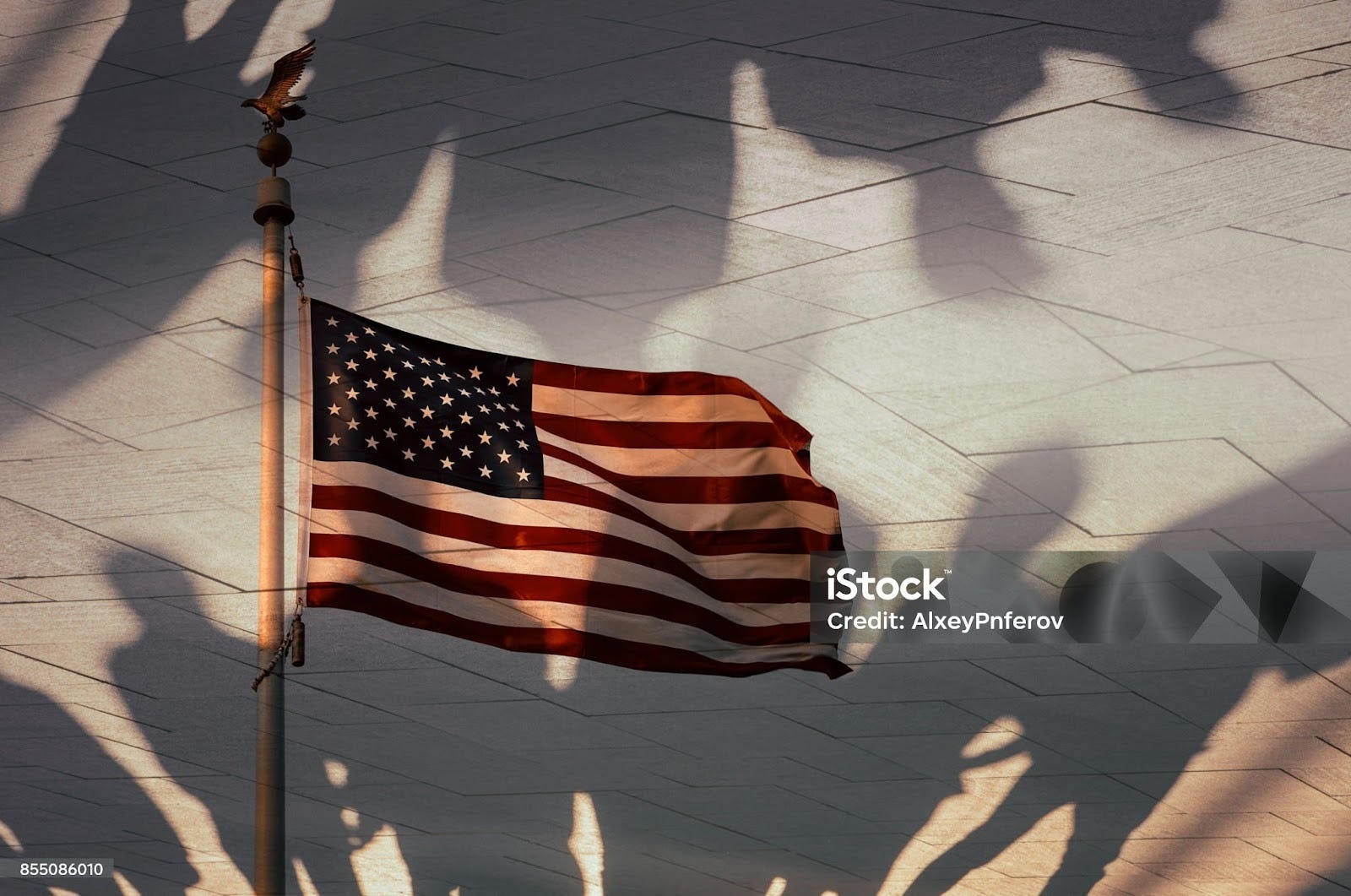
Watching the slow march to authoritarianism in the US is triggering for many of us in the national security community who lived in authoritarian states. How can this be happening in America, when we all worked for decades against such countries that espoused ideals anathema to what our country was founded upon?
My time serving for the US government in Syria was a defining moment not only in my career, but also my life. The notion of “American exceptionalism” and former President John F. Kennedy’s mantra of America as a “bright shining city on a hill” meant something to the US embassy personnel, as we witnessed first hand a country under the thumb of a despotic ruler, former Syrian President Bashar al-Assad. And we were all in awe of the Syrian people, who actually looked to the embassy as a refuge from the awful nature of the regime. America stood for both political freedom and economic liberalism; the Syrian people knew this and voted with their feet. They may have hated US policy, but they sure loved American ideals and values. We knew this because they stood outside the consular section day after day, in long lines, trying to obtain a visa to even just visit the US. Syrian elites tied to the regime also tried to obtain visas-that was their escape valve in the event that they ran afoul of the Assad regime. That to me was most telling. They hated their government and saw the US as the land of opportunity.
Most Middle East hands from the US government often state that one of their favorite postings was Damascus. Why is that? In my experience, while the work was invigorating, it was the Syrian people that made the posting so magical. They proved to be kind and hospitable and an absolute joy to live among. My children grew up there, and I retain many Syrian friends to this day. Memories of “Faruq’s” shawarmas in Malki, “La Montagne” pizza with a glorious view of Mount Qasioun and the “Shell Club” in Yafur are part of my family’s history.
This was in stark contrast to the political repression that Syrians faced, the secret prisons, the constant surveillance, and endemic corruption. Half a million or more Syrians were killed at the hands of Assad. Thousands of Syrians languished in prisons, whose depraved conditions were made public when the regime finally fell. Many of us who knew life in Syria felt the dark side of life there, which included a pervasive fear of the police state that was real and palpable as you walked the streets. We used to darkly joke that you could tell the temperature of the potential for tension in Syria by where the guns of the security forces were pointed. To the ground, you knew the regime was feeling relaxed. At the chest, an indication that tensions were high. Overall, it was a regime that practiced industrial-scale depravity. But the people remained remarkably resilient. And when the Assad regime finally fell in late 2024, it was a time of great joy.
Living in Damascus under Assad, I had a short daily walk to the embassy from our apartment in Abu Rumaneh. And I loved the times (even when called in after hours at night) when I would approach the US embassy and view the silhouette of the American flag, lit up and flying proudly, as I knew it meant something to the Syrian people (as well as the Americans at post). We were a small embassy staff, but the power of the US never felt greater than in those days.
Donald Trump’s America is not yet like Assad’s Syria. It is not required to make such hyperbolic comparisons. But alarm bells are ringing in the US today, and caution is in order. Incredibly, some aspects of life in Syria ring true for America. Secret police snatching people off the streets. A breakdown in the rule of law, with co-equal branches of government no longer functioning. Retribution against so called “enemies of the state.” And a powerful unitary executive who believes that all dissent is criminal. The Syrians threw all that out several months ago, when Assad fled to Moscow. We should not be heading in the opposite direction.
Marc Polymeropoulos worked for 26 years for the US government and retired from the senior intelligence service in 2019. He served in a variety of diplomatic, operational and management roles in the Near East and South Asia regions, with extensive time in Iraq and Afghanistan. He is the recipient of the Distinguished Intelligence Medal, the Intelligence Medal of Merit, the Intelligence Commendation Medal and the Distinguished Career Intelligence Medal. Polymeropoulos is a MSNBC national security contributor, a non-resident senior fellow at the Atlantic Council, an expert at the Agora Strategy Institute, and a member of The Steady State.
Founded in 2016, The Steady State is a nonpartisan, nonprofit 501(c)(4) organization of more than 290 former senior national security professionals. Our membership includes former officials from the CIA, FBI, Department of State, Department of Defense and Department of Homeland Security. Drawing on deep expertise across national security disciplines including intelligence, diplomacy, military affairs and law, we advocate for constitutional democracy, the rule of law and the preservation of America’s national security institutions.
Well-written —- the alarm bells are indeed ringing in America.
Marc, agree! Stay safe