The Wrong Question About Venezuela
The Steady State | by Steven A. Cash

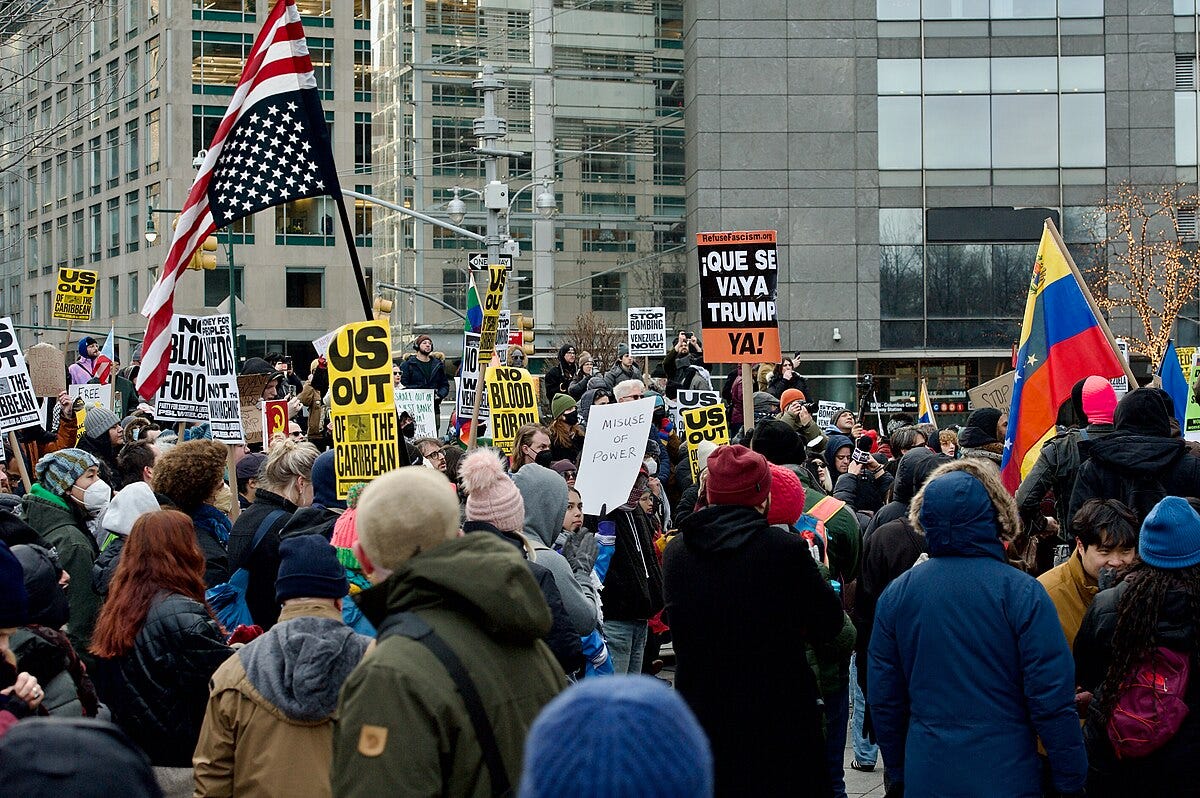
New York City Demonstrations in response to US operations in Venezuela - January 3, 2026
Begin with the terrifying thought: “What if the people now exercising power in Washington truly intend not merely to strike Venezuela, or to coerce it, but to run it?” The President has said as much.
That is the question increasingly discussed in policy circles, newsrooms, and foreign capitals. And it is usually followed by another, more familiar one: does this mean a long, bloody, expensive, and ultimately unsuccessful effort—another Iraq, another Afghanistan, another Vietnam?
That question, however understandable, is the wrong one.
For Americans, the concept of “occupation” carries a particular moral and historical frame. We think of military intervention followed—however haltingly and sometimes fecklessly—by an effort to build democratic institutions, protect civilians, and establish the rule of law. And then leave. Even when those efforts fail, or only partially succeed, they are animated by a set of constraints we regard not as weaknesses, but as virtues: respect for human rights, protection of civilian life, due process, proportionality, and accountability.
Those constraints are real. They matter. And they have consequences.
They mean that American forces operating abroad often do so with what soldiers themselves have long described as “one hand tied behind our back.” We impose rules of engagement. We accept legal oversight. We investigate ourselves. We tolerate—far more than our adversaries—the risk that restraint will be exploited by insurgents, terrorists, and armed resistance movements who do not share our values.
We are proud of this. We should be. It is the difference between power exercised under law and power exercised without it. It is also why nation-building, stabilization, and counterinsurgency are so frustratingly difficult—and so often unsuccessful.
But what if that is not the model being contemplated this time?
Recent rhetoric from senior officials—including the President and Secretary Hegseth—suggests a radically different conception of what American power should look like abroad. Gone is the language of stabilization, reconstruction, or democratic transition. In its place is a vocabulary of “warriors,” of lethality, of unconstrained effectiveness, and of contempt for what is derided as “tepid legalism.” It is the language of acquisition, of taking, of valuable assets.
This is not the language of the Marshall Plan. It is not the logic that governed the postwar occupations of Germany or Japan. It is not even the flawed, self-constraining logic that shaped American conduct—however imperfectly—in Vietnam, Iraq, or Afghanistan.
It is something older, colder, and far more frightening.
The model implicitly invoked is not American liberal internationalism, but imperial occupation: the Rome of conquered provinces, the Germany of occupied France and Romania, the Japan of occupied Manchuria. Occupations unconcerned with legitimacy, uninterested in consent, and indifferent to law except as a tool of domination – not justification, which has already been provided by the fact of power. Occupations in which overwhelming violence is not a regrettable last resort, but a governing principle. Where the objective is not self-rule, or justice, or democracy, but extraction—of resources, of labor, of strategic advantage—without interference.
In such a model, there are no meaningful rules of engagement. There is no serious consideration of civilian harm. Human rights are not constraints to be balanced, but obstacles to be dismissed. Law is not a framework, but a nuisance. The tactical advantage of amorality.
And crucially, this model does not fail in the same way American occupations fail. It does not collapse under the weight of its own restraint. It succeeds on its own terms—through fear, repression, and brutality—until it exhausts itself morally, politically, and often economically. And that failure comes neither quickly nor inevitably. And, it may be effective. If the goal is oil, or minerals, or territory, or simply power.
If this is the framework now animating U.S. policy toward Venezuela, then comparisons to Iraq or Afghanistan are dangerously misleading. Those were failures of ambition constrained by law and ethics. What is being advanced by President Trump is something else entirely: ambition freed from both.
That possibility—not whether Venezuela will become “another Iraq”—is the true source of dread. Is the goal an Empire of the Americas, ruled from Washington with power and violence? Donald Trump as Emperor of the West, gathering wealth from the tributary nations?
Because the most profound danger is not what such an occupation would do to Venezuela. It is what it will do to the United States—to our military, our institutions, our constitutional order, and our understanding of who we are when we wield power beyond our borders. Americans believe, with real justification, that we are the good guys. Imperfect, yes, but a force for good. We are proud of the Marshall Plan, and the emergence of Germany and Japan, of allies and democracies.
But Donald Trump and those around him may not share this view – for them, good guys are suckers.
Steven A. Cash served as a prosecutor in the Manhattan District Attorney’s office before joining the CIA in 1994 as Assistant General counsel and subsequently serving as an intelligence officer in the Directorate of Operations. In 2001 he joined the Senate Select committee on Intelligence as Counsel and designee-staffer to Senator Diane Feinstein). He later served as a senior staffer in the House Select Committee on Homeland Security, the Department of Energy, the Senate Judiciary Subcommittee on Terrorism, Technology and Homeland Security and the Department of Energy. In the private sector he has advised on national security, counterintelligence, and technology policy and served on the Biological Sciences Experts Group under the Director of National Intelligence. Mr. Cash is currently the Executive Director of The Steady State.
Founded in 2016, The Steady State is a nonprofit 501(c)(4) organization of more than 360 former senior national security professionals. Our membership includes former officials from the CIA, FBI, Department of State, Department of Defense, and Department of Homeland Security. Drawing on deep expertise across national security disciplines, including intelligence, diplomacy, military affairs, and law, we advocate for constitutional democracy, the rule of law, and the preservation of America’s national security institutions.
Yesterday, White House deputy chief of staff Stephen Miller told CNN’s Jake Tapper: “We live in a world, in the real world, Jake, that is governed by strength, that is governed by force, that is governed by power,” he said. “These are the iron laws of the world since the beginning of time.” That’s not the rule of law, nor is it the Constitution. How do we overpower these people and their donors?
This is effectively the model being applied to immigrants (or look like immigrants) in our cities by ICE.