
Trumping the Rules-Based International Order
The Steady State | by Greg Rushford

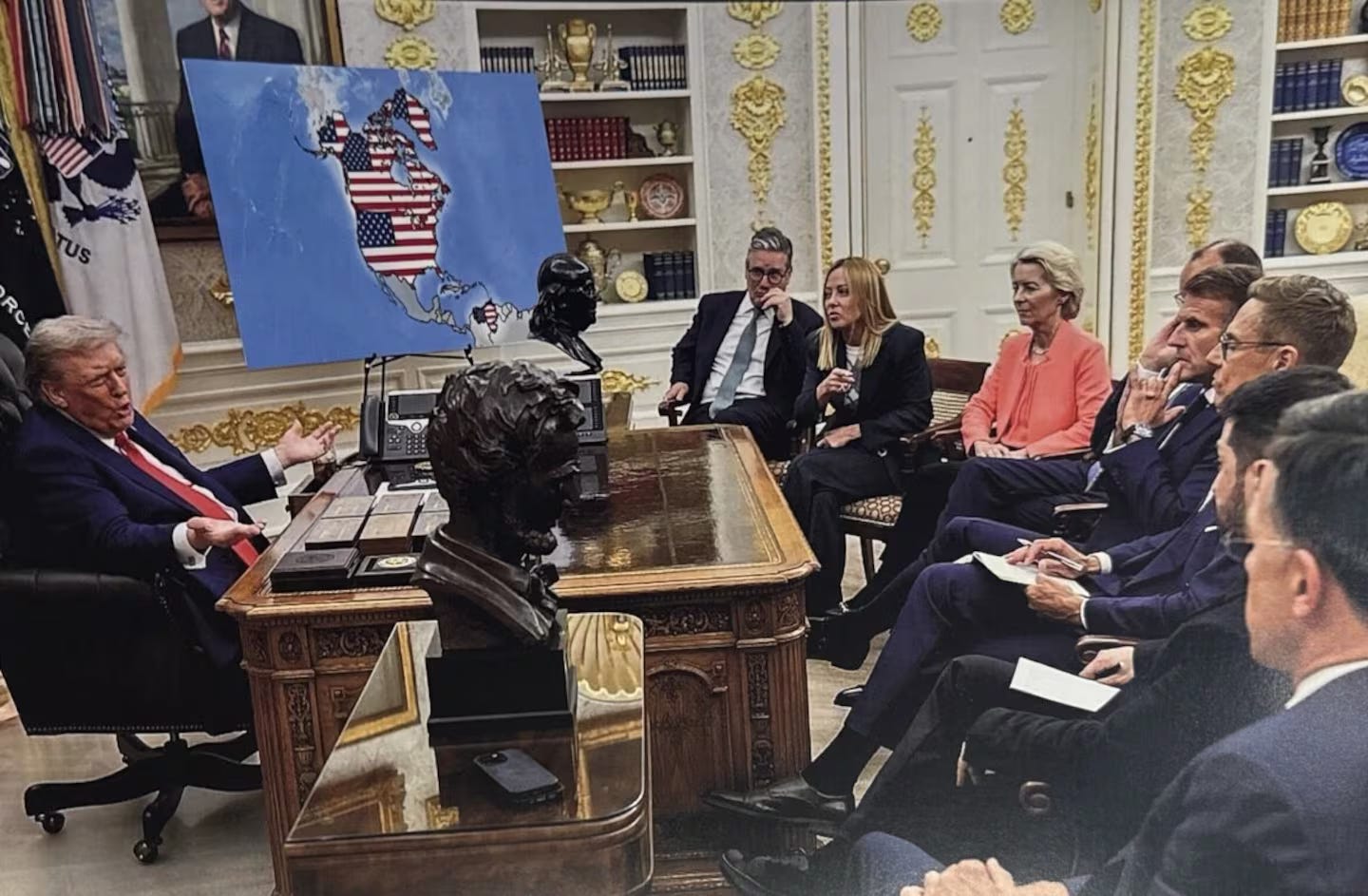
An altered image that U.S. President Donald Trump posted on Truth Social features the American flag superimposed over a map that includes Canada and Greenland (Donald J. Trump via Truth Social)
Masked federal agents on the streets of American cities: Snatching innocents. Trampling constitutional guarantees of due process. Defying judicial orders to cease and desist. Violent rioters who stormed the US Capitol: Pardoned, along with corrupt politicians (even including a major narcotics trafficker from Honduras). Federal prosecutors and FBI agents who worked to hold such criminals accountable: Fired.
Meanwhile, the president’s loyalists at the Department of Justice and FBI have been busy rounding up the usual suspects: the president’s perceived political enemies. Such authoritarian abuses of the rule of law have dominated daily headlines since Donald Trump returned to the (now gold-plated) Oval Office thirteen months ago.
America’s democratic backsliding has been “the most rapid in contemporary history,” Financial Times columnist John Burn-Murdoch has (painfully) observed. “It outpaces the early stages of backsliding under Russia’s Vladimir Putin, Turkey’s Recep Tayyip Erdogan and Hungary’s Viktor Orban, where similar steps unfolded over several years.”
It’s the same for America’s traditional respect for international legal norms that have shaped the world for the past eight decades.
Don’t take my word. The president and his subordinates have been operating in broad daylight.
On Jan. 23, Defense Secretary Pete Hegseth (a proud manosphere denizen who prefers to be called War Secretary) sent a memo to the Pentagon’s top brass, introducing the Trump administration’s 2026 National Defense Strategy. Previous American presidents, Hegseth wrote, had “squandered our military advantages and the lives, goodwill, and resources of our people in grandiose nation-building projects and self-congratulatory pledges to uphold cloud-castle abstractions like the rules-based international order.” President Trump, Hegseth added, “has decisively changed that.”
Indeed. Think about the “War” secretary’s derisive phrase: “cloud-castle abstractions like the rules-based international order.” China’s Xi Jinping and Russia’s Vladimir Putin talk like that. No American president ever has. Until now. As senior White House strategist Stephen Miller has put it, the world has always been dominated by raw “power.” Period.
In 1945, after the end of World War II and the loss of more than 70 million lives resulting from similar thinking, the United Nations – led by the United States – was launched. The driving idea, enshrined in the UN’s preamble, was “to establish conditions under which justice and respect for the obligations arising from treaties and other sources of international law can be maintained.” Four years later, NATO’s charter reaffirmed those democratic ideals.
NATO’s Article I specifies that signatory members of the North Atlantic Treaty are (legally) required “to refrain in their international relations from the threat or use of force in any manner inconsistent with the purposes of the United Nations.”
Unimpressed, Trump has spent the past year threatening to seize --- “one way or the other” --- Greenland, the semi-autonomous territory of fellow NATO ally Denmark. While he has backed off (for now) in the face of international revulsion, the damage has been incalculable.
Just ask Canadians, who will not soon forget that Trump actually said --- in the Oval Office, in front of Canadian Prime Minister Mark Carney --- that the map of North America would look better if Canada would surrender its sovereignty and become the 51st U.S. State.
Don’t laugh. Trump’s serious. Never mind the absurdity of weakening the vitally important US-Canadian defense and intelligence-sharing arrangements that have long protected North America from Russian aggression.
Canadians --- who have aggressively resisted Moscow’s designs on Ukraine and the Baltics --- have grown used to being targeted by Russian information warfare. Now, they have a new worry: the MAGAphone. “Canada is now considered a hostile actor by MAGA,” noted Canadian journalist John Ivison in the National Post.
Far-right separatists in Canada’s oil-rich Alberta province have been meeting with Trump’s U.S. State Department diplomats, according to a well-sourced report in the Financial Times. One even boasted that he had a “much stronger relationship” with officials in Washington than Ottawa. Treasury Secretary Scott Bessent piled on last month, saying that Alberta was “a natural partner for the US.” Trump himself has close ties with right-wing “influencers” on both sides of the border.
Meanwhile, Trump is pushing a new idea to move on from the traditional rules-based international order. He is working up a “Board of Peace” with like-minded countries interested in, for openers, funding real estate projects in war-ravaged Gaza.
The board’s funds would be controlled by Trump (with input from son-in-law Jared Kushner and others close to the family). The initial members include the familiar autocratic regimes whose leaders Trump admires: Saudi Arabia, Turkey, and Hungary. Not one European democracy.
Trump has invited Russia’s Putin to join, while conspicuously disinviting Canada’s Prime Minister Mark Carney. A man who knows how to handle bullies, Carney’s popularity has risen in direct proportion to the continuing insults and threats from the president of the United States.
Greg Rushford is a former congressional aide who conducted intelligence oversight, and a former Washington journalist. He is a member of The Steady State.
Founded in 2016, The Steady State is a nonprofit 501(c)(4) organization of more than 360 former senior national security professionals. Our membership includes former officials from the CIA, FBI, Department of State, Department of Defense, and Department of Homeland Security. Drawing on deep expertise across national security disciplines, including intelligence, diplomacy, military affairs, and law, we advocate for constitutional democracy, the rule of law, and the preservation of America’s national security institutions.