
When Public Power Becomes a Racket
What RICO’s Framework Reveals About Allegations of Government Extortion

By Steven Cash
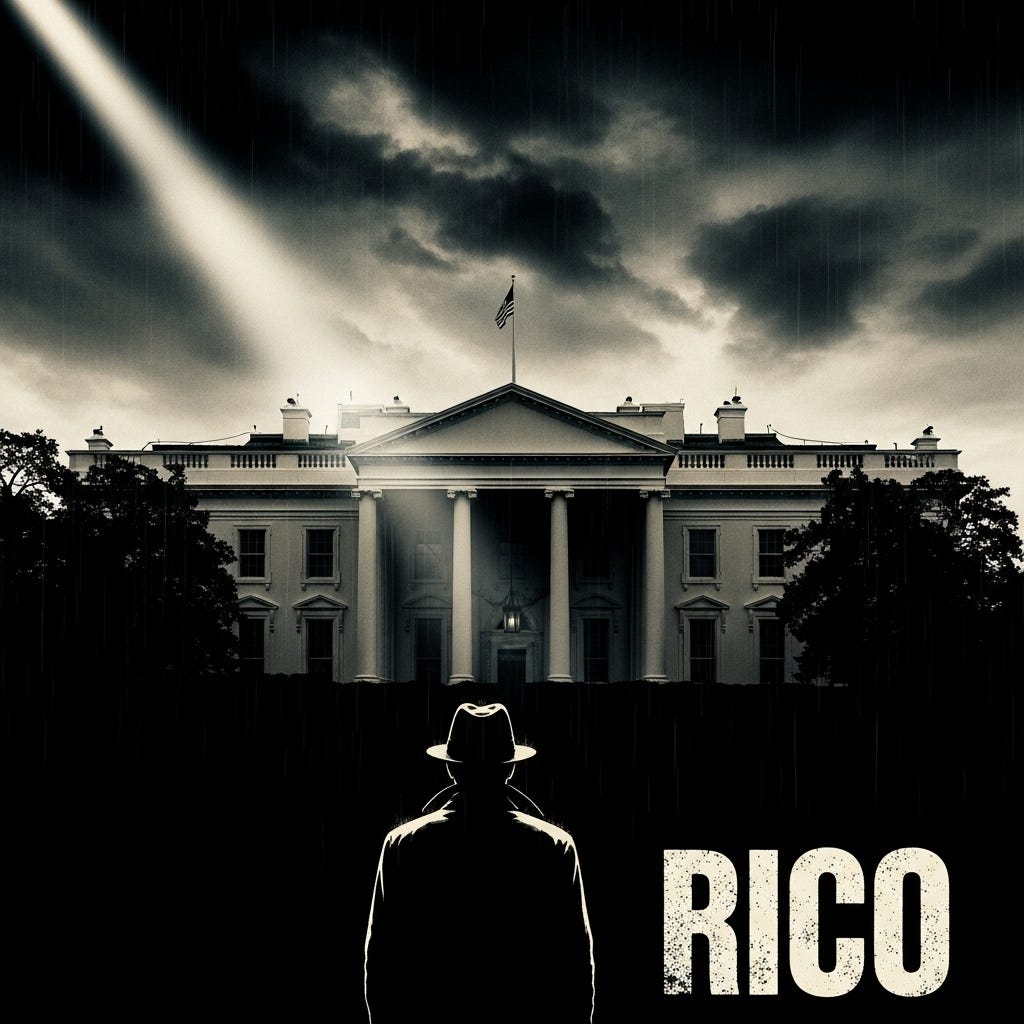
The Racketeer Influenced and Corrupt Organizations Act—better known as RICO—was written for mobsters, not presidents. Passed in 1970 to dismantle organized crime, it gave prosecutors, and even private citizens, a way to take down enterprises that abused organizational power for private gain.
RICO is not about who wears the wide pinstripe suit or holds public office—it is about how power is used. The same legal framework that once brought down corrupt labor bosses and bribed judges applies whenever officials repeatedly leverage institutional authority to extract concessions or retaliate against opponents.
Understanding RICO’s principles provides a structured way to evaluate whether government power has been turned into a tool of extortion.
RICO 101
RICO prohibits four things: (1) conduct, (2) of an enterprise, (2) criminal conduct (3) through a pattern, (4) of racketeering activity. Courts have interpreted these terms broadly.
An “enterprise” can be any association—formal or informal—whose members work together for a common purpose. It can be a La Cosa Nostra crime family, a labor union, a police department, or a mayoral office. RICO is designed for where crime is carried out not by a person, or even a small conspiratorial group of persons, but by something with more substance – an organization with a life and identity of its own.
If there is an enterprise, the attention turns to the criminal conduct and pattern of racketeering. The statute includes a long list of “predicate” crimes that constitute conduct, which include murder, kidnapping, extortion, arson, robbery, bribery, gambling, dealing in obscene matter, drug trafficking, money laundering, counterfeiting, mail fraud, wire fraud, embezzlement, obstruction of justice, and witness tampering. One of those crimes is the “Hobbs Act” makes it a crime to obtain property “under color of official right.” Courts have ruled that this includes soliciting payments, services, or favors in exchange for official action—even when disguised as campaign contributions.
Finally, courts look to find a “pattern” – is the criminal conduct part of the fabric of how the enterprise is being run. It does not have to be the only thing - labor unions, often a target of RICO, still do worker representation, even if they are also running part of the business by committing crimes.
Civil RICO, unlike criminal RICO, is available to private citizens who suffer business or property injury as a result of such conduct. That means victims of coercion—contractors, law firms, or universities pressured into giving up money or services—could, in theory, sue for treble damages.
RICO and Trump
The question here is whether the activities of the various Trump entities (“Trump Incorporated”?), including, perhaps the Office of the President, and extending out to The Trump Organization, and the multitude of subsidiary or related corporations, fit RICO. Are these entities, in whole or in part, an “enterprise”? Are they being run through a pattern of criminal conduct?
Allegations about the conduct of the Trump entities, including the Office of the President, take on a different cast when viewed through this lens. Examples include:
Law Firms Targeted: Early executive orders reportedly banned lawyers from certain firms from government buildings, revoked security clearances without cause, and threatened to cancel government contracts with their clients. According to multiple accounts, this pressure led firms—including Skadden, Arps and Paul, Weiss—to provide millions of dollars in free legal work aligned with administration policies.
Universities Pressured: Top universities were allegedly pushed to suppress speech critical of the administration. Columbia University eventually complied; Harvard University refused, filing suit to protect its First Amendment rights.
Pay-to-Play Favors: Investigative reporting has described a broader pattern of transactional politics, including allegations that pardons, regulatory relief, and government access were offered in exchange for financial or political support. One example involved $148 million raised through a so-called “Trump Meme Coin,” which reportedly granted large purchasers an invitation to a private dinner with the president.
If substantiated, these actions would fit comfortably within the Hobbs Act’s definition of extortion, as well as perhaps other crimes which RICO treats as a predicate offense.
And RICO has been used against public officials before. In the 1980s, the Justice Department used RICO to purge organized crime from the Teamsters union, exposing political payoffs. In “Operation Greylord”, a Chicago-based bribery network involving judges and lawyers was dismantled under RICO, showing that public officials can themselves constitute a racketeering “enterprise.”
A more recent example underscores how RICO’s civil provisions are being tested against public officials. In 2025, former NYPD Commissioner Thomas Donlon filed a civil RICO action against the Office of the Mayor of New York City, alleging that senior municipal officials orchestrated a pattern of extortion and favoritism in awarding contracts. Contractors were allegedly threatened with losing permits and approvals unless they directed business to politically connected firms.
This is not about partisan politics. It is about the structural risk of letting public power be converted into a personal racket. RICO provides a neutral, evidence-based framework for determining when a government has crossed that line.
The key questions are always the same:
• Was there an identifiable enterprise, formal or informal?
• Was public authority used to extract money, services, or political concessions?
• Was this conduct repeated, forming a pattern of racketeering activity?
The office held by the alleged wrongdoer—whether a city mayor or a U.S. president—should not change the analysis. If a local mayor’s office can be scrutinized under RICO, so can the executive branch. Whether anyone will bring such a case is another matter, but the framework exists, and it has been used before against powerful officials. We can use it now, if not in court, then in helping us think about describing the unique events that are dramatically reshaping America. Understanding that framework—and applying it objectively, in Court, and in ordinary discussions—is the first step toward ensuring that public institutions do not slide toward becoming rackets in all but name.
Steven Cash is the Executive Director of The Steady State. Until recently, he served as Senior Advisor the Under Secretary for Intelligence at DHS. He began his career in the Rackets Bureau of the Manhattan District Attorney’s Office. He was Chief Counsel and Staff Director (Minority) to a subcommittee of the Senate Judiciary Committee, and Chief Counsel to Senator Dianne Feinstein. He served as Chief of Staff to the Director of Intelligence, DoE; as Staff Director to the House of Representative's Committee on Homeland Security; and as a Professional Staff and Counsel to the SSCI. He served at CIA 1994-2001, first in OGC, and then with the Directorate of Operations.
This analysis, with its lawyer’s precision, highlights another sign of our troubled times. Experienced, non-partisan lawyers with familarity in dealing with racketeering are watching today’s wheeling-and-dealing in our country’s highest political and legal circles —- with a sense of déjà vu.