
When Trust is Lost
The Steady State | by Greg Rushford

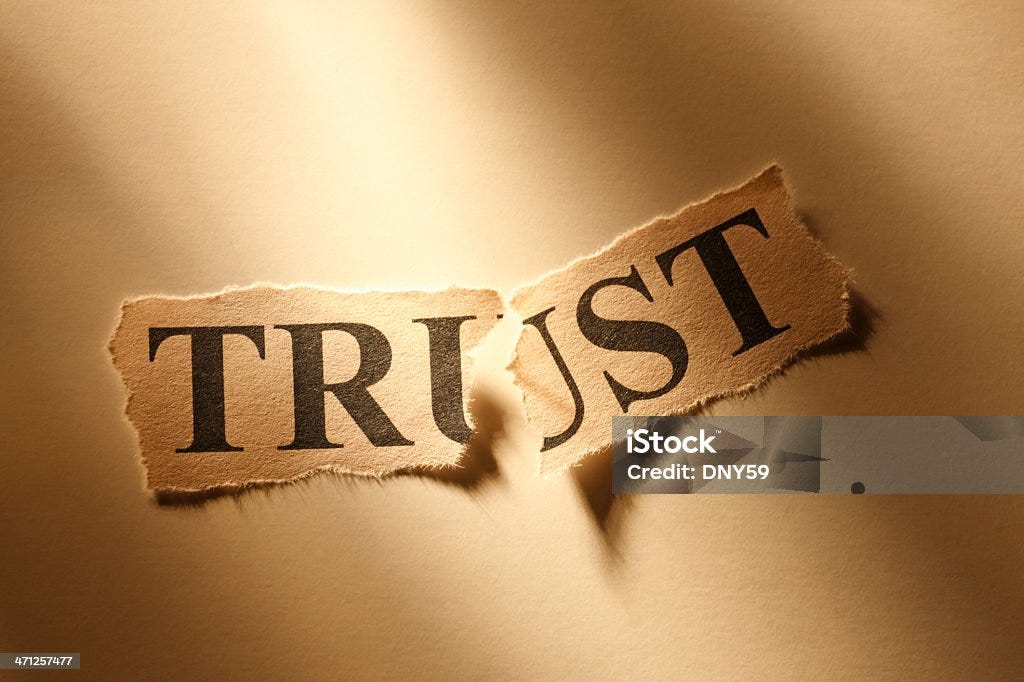
Trust --- earning and keeping it, while treating others respectfully --- is the key to effective diplomacy, as in all human relations. When trust is damaged between countries, adverse national security consequences will inexorably follow.
So, it’s of great concern that our closest trading- and security partners have reasons not to trust America’s word anymore.
“Can any deal with the US be counted on to last?” former Canadian trade minister Mary Ng has recently asked. With President Donald Trump, she added, Canada has learned that “even negotiated, signed, and ratified commitments may no longer be guaranteed.”
Senior officials in other important U.S. security partners ---notably Denmark, France, Germany, South Korea, Australia and Japan --- share Ng’s concerns. Trump “is not a normal person,” Japan’s normally low-key Prime Minister Shigeru Ishiba has observed. “He’s someone who changes the rules.”
For a closer examination at what squandered American trust looks like, consider recent American economic- and security diplomacy targeting Switzerland, an example that is being duplicated throughout the world.
As the Wall Street Journal, the Economist and numerous others have well-reported, Trump shocked the Swiss on August 1, their national holiday. That’s when he hit Switzerland’s exports to America with crippling 39% duties that recalled the disastrous U.S. Smoot-Hawley tariffs of 1930.
Trump asserted, with classic “America First” isolationist rhetoric, that the Swiss were “unfair” trading partners. (Switzerland imposes “zero” tariffs on U.S. goods; at the start of this year, America’s industrial tariffs averaged 2.3%) When Swiss President Karin Keller-Sutter tried to explain Econ 101 on the phone in late July, she got nowhere. Trump, who had been blustering about inflicting “only” 31 percent punitive tariffs, hiked them to 39%.
Trump --- who boasted at a recent Republican black-tie dinner that world leaders have been “kissing my ass” as they grovel for favorable trade deals --- refused to meet with his Swiss counterpart when she flew to Washington last week to try to talk sense.
Swiss headlines have been screaming. “You’ll regret this, Donald,” warned Blick, a Swiss-German newspaper with the country’s largest online presence.
Swiss news outlets have been hammering at the hypocrisy. Trump has acted to make Swiss chocolate and cheese more expensive for ordinary Americans --- but the president and his golf buddies have enjoyed displaying their expensive Rolex watches on the greens. Not to mention all those Trump family ski vacations in the Swiss Alps.
As night follows day, security concerns are rising along with the tariffs. Switzerland agreed in 2022 to buy three dozen American F-35 fighter jets, for $7.4 billion. Swiss newspapers and some leading politicians are scandalized that the Americans are now demanding a billion-dollar price hike before delivery.
While the F-35 deal may survive, other concerns are being voiced, particularly regarding the newly-created espionage opportunities. Switzerland’s Federal Intelligence Service, known as the FIS, released its 2025 annual report last month. The Swiss spooks documented a rising array of espionage threats beginning with Russia and China. But one sentence stood out: “President Trump’s selective, transactional and often unilateral policies are exacerbating global insecurity and uncertainty.”
Add doubts about lost trust involving the crucial Five Eyes intelligence-sharing relationship to that mix.
Five Eyes grew out of British-US codebreaking during World War II, and now also includes Canada, Australia and New Zealand. How important is this? Imagine an airline pilot turning off the radar in a storm, preferring to fly blind. Disturbing questions have slipped into the public domain about whether America’s Five Eyes partners can really trust us not to flip that switch.
The White House has quietly insinuated that Canada’s Five Eyes’ access could be cut off, if Ottawa keeps resisting Trump’s tariff threats, according to plausible sounding press reports --- never officially confirmed or convincingly denied. And CBS News has reported that US intelligence officials have cut-off Five Eyes’ access to intelligence involving Russia and Ukraine.
There have been no signs that the Republican-led congressional intelligence committees have been trying to get to the bottom of this.
Elsewhere --- “We no longer know if we can ‘count on the Americans,’” Norwegian scholar Mathilde Fasting has written. We’ve seen the White House “blame Ukraine for starting the war, call the Ukrainian president Volodymyr Zelensky a dictator and publicly shame him in the Oval Office, support the AfD in Germany, threaten Denmark with acquiring Greenland, and urge Europe to take care of itself or ‘clean up its mess.’”
Such distrust is also on the rise with key U.S. Pacific allies which have been hammered by America First tariffs. In Seoul, public support for acquiring a South Korean nuclear deterrence is rising. Nobody dares say that out loud in Tokyo --- yet.
A parting thought: When America was attacked on Sept. 11, 2001, the world --- including NATO and other security allies --- came to our defense. Our word, along with respect for our fundamental decency, was trusted. Then.
Greg Rushford is a former congressional aide who conducted intelligence oversight, and a former Washington journalist. He is a member of The Steady State.
Founded in 2016, The Steady State is a nonpartisan, nonprofit 501(c)(4) organization of more than 300 former senior national security professionals. Our membership includes former officials from the CIA, FBI, Department of State, Department of Defense and Department of Homeland Security. Drawing on deep expertise across national security disciplines including intelligence, diplomacy, military affairs and law, we advocate for constitutional democracy, the rule of law and the preservation of America’s national security institutions.