
Complaint and Request for Investigation into Partisan Political Activities by Secretary of Defense Pete Hegseth in Violation of the Hatch Act and Department of Defense Hatch Act Policy

On May 18, 2026, Defense Secretary Pete Hegseth appeared and spoke before a campaign rally in support of Republican candidate Ed Gallrein in Hebron, Kentucky. Secretary Hegseth’s appearance violated the Hatch Act as applied by clear, unambiguous and long-standing Department of Defense (DoD) policy prohibiting such political activity by DoD Presidentially-appointed, Senate-confirmed (PAS) officials. The Steady State, an organisation of over 420 former national security and intelligence officials, many of whom are former members of the military, submits this Complaint and Request for Investigation to the U.S. Office of Special Counsel (OSC), the agency charged with and responsible for investigating and enforcing Hatch Act violations.
I. Factual Background
On May 18, 2026, the nonprofit organization, America First Works, held a campaign rally in Hebron, Kentucky, in support of Ed Gallrein, a candidate for the U.S. House of Representatives for Kentucky’s 4th District in a highly contested race against incumbent Rep. Thomas Massie, the latter of whom had enraged President Trump over past year due to disagreement on matters such as the budget and handling of the Epstein files. According to media reports, President Trump spent months leading up to the primary searching for a replacement for Massie, eventually recruiting Gallrein to run in October 2025.
Defense Secretary Hegseth appeared at the rally in person and took the stage in support of Gallrein and against Massie. As noted by local media, the Kentucky Lantern, “Secretary of Defense Pete Hegseth came to Hebron to stump for Gallrein.” His appearance and remarks were made less than 24 hours before polls opened for the GOP primary in Kentucky on Tuesday, May 19, 2026.
After he was introduced, Secretary Hegseth began his remarks with the following statement “I have to say upfront for the lawyers, that I’m here in my personal capacity as a private citizen, fellow American, and fellow combat veteran here to support Navy S.E.A.L. Ed Gallrein.” No explicit mention of the Secretary’s title was made in the introduction or his remarks. His remarks, however, were replete with references to his role, if not title, as Defense Secretary. For example, he was clearly speaking as the Defense Secretary when he noted “something that President Trump told me when he first offered me this job” i.e. the position of Defense Secretary. Earlier in the day, the Defense Secretary had visited the 101st Airborne Division at Fort Campbell, Kentucky where he conducted a re-enlistment ceremony and presented Purple Heart medals to nine service members. He referred to his visit to Fort Campbell in his remarks at Gallrein’s rally. Secretary Hegseth’s presentation also was laced with remarks about the ethos of the military warrior and the need for our warriors to support President Trump by electing individuals such as Mr. Gallrein, because “we need the tough vote to beat Left-wing lunatic Democrats the most.”
As discussed below, Secretary Hegseth’s campaign speech at the May 18, 2026, America First Works Rally, violated the federal Hatch Act and long-standing DoD Hatch Act policy.
II. The Hatch Act Generally
Restrictions on the political activities of federal executive branch employees are not new but have existed for almost 150 years since the enactment of the Pendleton Act in 1883 and establishment of the Civil Service Commission. Congress enacted the Hatch Act in 1939, officially titled “An Act to Prevent Pernicious Political Activities.” As originally enacted, the Hatch Act prohibited nearly all federal employees from taking an active role in political management or campaigns.
In 1993, the Act was amended significantly under the Hatch Act Reform Amendments to allow most Federal employees, both career civil servants and political officials, to engage in certain types of political activities while in their personal capacity. The statute provides that “[i]t is the policy of the Congress that employees should be encouraged to exercise fully, freely, and without fear of penalty or reprisal, and to the extent not expressly prohibited by law, their right to participate or to refrain from participating in the political processes of the Nation.” In accordance with this provision, all executive branch employees can freely exercise their constitutional rights to, among others, vote or not, join a partisan political party or not, to donate to a partisan political candidate or campaign or not, subject to restrictions necessary to maintain a nonpartisan career civil service. As stated by the OSC, “[t]he law’s purposes are to ensure that federal programs are administered in a nonpartisan fashion, to protect federal employees from political coercion in the workplace, and to ensure that federal employees are advanced based on merit and not based on political affiliation.”
The Hatch Act, 5 U.S.C. §§ 7321-7326, restricts the involvement of Federal executive branch employees in partisan political activities. The Act does not apply to activities of the President and Vice President, members of uniformed services, or of the Government Accountability Office. The Act governs the political activity of federal civilian executive branch employees to protect the federal workforce from partisan political influence.
The Hatch Act generally prohibits federal employees, both career civil service and political officials, from engaging in partisan political activity while on duty, in a federal facility, or using federal property, in uniform or official insignia identifying the office or position of the employee, or in a vehicle owned or leased by the federal government. “Political activity” is defined under OPM regulations to mean “an activity directed toward the success or failure of a political party, candidate for partisan political office, or partisan political group.”
The Hatch Act and its implementing regulations (5 C.F.R. Part 734) generally identify two sets of restrictions – “lesser restricted” and “further restricted” activities or employees -governing engagement in political activity by executive branch employees. These two sets of restrictions are applied to the following four groups of career and/or political personnel.
1. Less Restricted
Most executive branch employees are subject to lesser restrictions. “Less restricted” employees, include most career employees in the executive branch and often schedule C noncareer employees. These employees are authorized to participate actively in partisan political campaigns in their personal capacity if they are off-duty and not in a government facility, not in uniform or wearing indicia of their agency affiliation, or in a vehicle owned or leased by the federal government. As “less restrictive” employees, they may, among other activities, campaign for or against candidates in partisan elections, make campaign speeches or distribute campaign literature, endorse partisan candidates, hold office in partisan groups and engage in canvassing on behalf of a partisan candidate. A less restrictive employee, for example, in their personal capacity, could have made the remarks at Gallrein’s rally similar to those presented by Secretary Hegseth, without violating the Hatch Act.
2. Further Restricted
Employees subject to further restrictions include career executive services members (SES),
Administrative Law Judges, Administrative Appeals Judges, Contract Appeals Board Members, and employees of certain intelligence or law enforcement agencies or offices (except PAS), including the Federal Election Commission, Federal Bureau of Investigation, the U.S. Secret Service, the Central Intelligence Agency, the National Security Council, the National Security Agency, the Defense Intelligence Agency (DIA), and the Merit Systems Protection Board. As further restricted employees they are prohibited, even off-duty and on their personal time, from:
partisan political management (e.g. organizing rallies, holding office in political parties, or assisting with partisan voter registration drives);
actively participating in political campaigns through speaking or campaigning for or against candidates, sending campaign materials or circulating nominating petitions; or
addressing a convention, caucus, rally, or similar gathering of a political party or partisan political group in support of or in opposition to a candidate for partisan political office or political party office, if such address is done in concert with such a candidate, political party, or partisan political group.
3. Special Hatch Act Rules
PAS and employees paid from an appropriation for the Executive Office of the President, whose duties and responsibilities continue outside normal duty hours or are away from the normal duty post, are governed by special Hatch Act rules which are a hybrid between lesser and further restrictions. While the Hatch Act prohibits most employees from engaging in political activity while on duty, the Act exempts from this prohibition employees “who are deemed to be on duty at all times and who are appointed by the President with Senate confirmation.” Such PAS officials are thus authorized to engage in political activity as long as they are acting in their personal, not official capacity, and do not use federal funds to cover the costs associated with their political activity. Under this provision of the Hatch Act, PAS in most federal agencies are authorized to make campaign speeches for or against partisan political candidates if they are appearing in a personal capacity (so no title, indicia of position or agency) and do not use federal funds to support such appearance.
OSC has a detailed advisory outlining factors to be considered in apportioning use of federal funds for travel between official events and political activity in an employee’s personal capacity. The advisory provides that “when an exempt employee attends both official and political events during the same trip, agencies must apportion the travel costs between the federal government and the relevant political organization or candidate and ensure that the Treasury is appropriately reimbursed.” Those factors also include review of the circumstances surrounding the scheduling and intent of the official trip to ensure the official action was not a pretext for the official’s travel for the political activity.
PAS operating under the Special Hatch Act rules also must take care not to mix official appearances with personal appearances or actions that support partisan political campaigns. Cabinet members, for example, often are called on for media appearances to educate and/or support administration policies and operations. During federal election cycles, such officials have inadvertently been caught switching hats from official to personal during interviews when asked about their positions on upcoming elections or candidates or their own candidacy. Merely stating that they are “now” acting in their personal capacity does not cure the Hatch Act issue created by partisan political statements during an official appearance.
4. PAS Officials Excluded from Special Hatch Act Rules
Following enactment of the Hatch Act Reform Amendments, President William J. Clinton, in the Fall of 1994, issued memoranda to the Secretary of Defense, Secretary of State, and Attorney General delegating to them, under 3 U.S.C. § 301, the authority reserved to the President to limit the political activities of political appointees, including Presidential appointees with Senate confirmation. Subsequently, the heads of those Departments issued policies further restricting the political activities of PAS officials in both their official and personal capacities, thus excluding them from the special rules exemption. As a result, PAS for DoD, State, and Justice have been subject to “further restrictions” on political activities including in their personal capacity. As of the date of today’s complaint, the Department of Defense’s policy continues to prohibit PAS, including the Secretary of Defense, from engaging in specified political activities, including making a speech in favor of a candidate (and against another) in a partisan political rally.
III. DoD Policy Prohibits PAS Officials from Engaging in Partisan Political Activities.
DoD’s policy and guidance on political activities for its employees is found at the Department of Defense Standards of Conduct website at LINK. The opening page of the website sets forth a short outline on “Political Activities,” including clear chart on employees and political officials and their status with respect to Hatch Act restrictions on political activity:
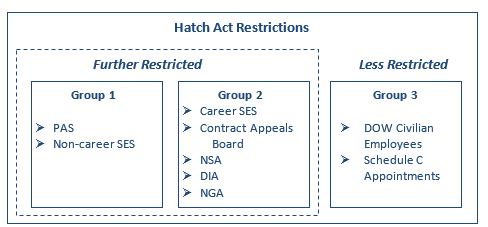
The guidance further notes that “[e]mployees in Groups 1 and 2 are prohibited from taking an active part in partisan political management or political campaigns and are referred to as ‘further restricted’ employees”.
DOD policy and guidance applying the Hatch Act further clarifies that speaking at a campaign rally on behalf of a partisan political candidate is activity “in concert” with a political party, campaign and/or candidate and therefore is prohibited for DoD PAS. As recently as March 2, 2026, DoD had issued reminder guidance specifically directed at PAS officials. That guidance provides:
Q: May PAS officials assist the campaign of a candidate running for partisan political office?
A: No. Under longstanding DoW policy, PAS officials are prohibited from taking an active part in partisan political management or political campaigns. Specifically, this means that these employees are prohibited from engaging in any political activity which is ‘in concert’ with a political party, partisan political group or candidate for partisan political office. ‘In concert’ activity is any activity that is sponsored or supported by a political party, partisan political group or candidate for partisan political office. For example, PAS officials are prohibited from: writing speeches or performing research on political issues for a partisan campaign; speaking at a campaign rally for a candidate for partisan political office; soliciting, accepting or receiving political contributions; holding office in a political party; hosting a fundraiser for a candidate for partisan political office; serving as a delegate to a political party convention or doing any type of volunteer work for a candidate for partisan political office.” (emphasis supplied).
The same language is set forth in separate guidance issued in February 2026, entitled “Partisan Political Activity Rules for “Further Restricted” DoW Civilians. Copies of both documents are attached to this complaint.
Career civil servants and political officials receive Hatch Act training as part of their ethics training when first brought on board and generally during each federal election federal agencies issue reminders and guidance on the restrictions on partisan political activity by executive branch employees and any changes to such restrictions. DOD does not appear to be any different. In January 2025, DoD issued a handbook to its incoming political officials, outlining, among other things, official responsibilities and legal policy matters. That handbook provides:
While most DoD employees are permitted to engage in political activity while off-duty and outside of Federal buildings, DoD policy prohibits senior political appointees, PAS, and non-career SES, from taking an active part in partisan political management or political campaigns. Specifically, this means that these senior political appointees, along with career SES employees, are prohibited from engaging in any political activity which is “in concert” with a political party, partisan political group or candidate for partisan political activity. Finally, Service members are also prohibited by DoD policy from engaging in political activity.
With the full legal and ethics resources in the DoD Office at the General Counsel at his disposal, it is difficult to believe that Secretary Hegseth would have been unaware or uninformed that he was prohibited from making campaign speeches, even in his personal capacity as a private citizen as he noted at the event.
IV. CONCLUSION
As noted above, on May 18, 2026, Secretary Hegseth appeared at a campaign rally for Ed Gallrein, a candidate for the U.S. House of Representatives for Kentucky’s 4th District in a highly contested race against incumbent Rep. Thomas Massie. As noted by local media, the Kentucky Lantern, “Secretary of Defense Pete Hegseth came to Hebron to stump for Gallrein.” His appearance and remarks were made less than 24 hours before polls opened for the GOP primary in Kentucky on Tuesday, May 19, 2026. While most cabinet members, such as the Secretary for Health and Human Services, Secretary of the Treasury or Secretary of the Interior, for example, would have been free to make a campaign speech in their personal capacity as private citizens, for Mr. Gallrein in Hebron, Kentucky on May 18, 2026, Defense Secretary Hegseth was expressly prohibited from making that speech by DoD’s Hatch Act policy for civilian personnel. Thus, his actions at the rally were in direct violation of the Hatch Act as administered by DoD’s Hatch Act governance policy.
The Steady State, based on the information set forth herein, urges the Office of Special Counsel to issue a finding that Defense Secretary Hegseth’s campaign speech on May 18, at the America First Works rally in Hebron, Kentucky, violated the Hatch Act as applied under DoD policy as delegated to DoD by presidential authority. We also request that the OSC review the circumstances surrounding the scheduling of Secretary Hegseth’s official travel to Kentucky on May 18 and visit to Fort Campbell before his appearance in Hebron, Kentucky, to ascertain whether federal funds were appropriately expended for his mixed travel for his official trip to Fort Campbell followed by his appearance at the campaign rally, and if federal funds were used inappropriately, direct appropriate reimbursement by Secretary Hegseth, the America First Works or the Gallrein campaign was made. We further request that the OSC conduct an investigation to determine whether Secretary Hegseth or any other DoD PAS, Presidential appointees or non-career SES have engaged in additional prohibited political activity during the current mid-term election cycle and/or expended federal funds for such purpose.
The U.S. Armed Forces are nonpartisan and apolitical, bound by the U.S. Constitution to serve civilian leadership regardless of party. Under DoD Directive 1344.10 “active-duty personnel may not engage in partisan political activities, and all military personnel should avoid the inference that their political activities imply or appear to imply DoD sponsorship, approval or endorsement of a political candidate, campaign or cause.”
We believe it is important to note that while the Hatch Act expressly does not apply to uniformed members of the armed services, DoD historically and to this day restricts political activities of active service members through DoD policy, recognizing the importance of an apolitical uniformed armed services. Violations of DoD policies have serious consequences for members of the armed forces under the Uniform Military Code.
The restrictions on DoD active service members are similar if not equivalent to those for “further restricted” PAS personnel (as well as career and non-career SES). For example, prohibited political activities for active service members include:
Use of official authority or influence to interfere with an election, affect the course or outcome of an election, solicit votes for a particular candidate or issue, or require or solicit political contributions from others.
Participate in partisan political management, campaigns, or conventions (except as a spectator when not in uniform) or make public speeches in the course thereof.
Speak before a partisan political gathering, including any gathering that promotes a partisan political party, candidate, or cause.
All of these are activities engaged in on May 18, by Defense Secretary Hegseth the man charged with leading U.S. active service members.
Compliance with the rule of law is necessary for a strong democracy. It is critical for our armed services and career leadership for DoD, no more so than now when the United States military is engaged in ongoing armed conflict in the Middle East as well as active engagements in the Western Hemisphere, that the American people have confidence in the operation of the U.S. military as nonpartisan services and that the men and women risking their lives to protect U.S. national security and the American people are doing so with full confidence that their civilian leaders are acting in the interests of national security and all of the American people, without regard to partisan politics.
Respectfully submitted,
Steven A. Cash
Executive Director
The Steady State
cashs@thesteadystate.org
212.685.9660
Mr. Hegseth clearly violated the Hatch Act. Equally as clearly, he will not be found guilty during this administration. Hopefully, there is no statute of limitations.
Excellent summary of the Hatch Act, which in and of itself is an important civics lesson. In service to our country, it shouldn't be too much to expect senior officials such as the Secretary of Defense to adhere to the law. Hegseth is not the only one in the current administration who seems to believe otherwise. This also underscores additional dangers lurking in the Roberts Majority's embrace of the Unitary Executive Theory as set forth in their recent Slaughter decision. If the Unitary Executive has ultimate and unchecked power over Executive Branch officials, what stops the President from turning the Hatch Act on its head and demanding that federal officials actively engage in partisan political activity in order to keep their jobs?