
When War Is Just a “Short Excursion”
The Steady State | by Martha Duncan

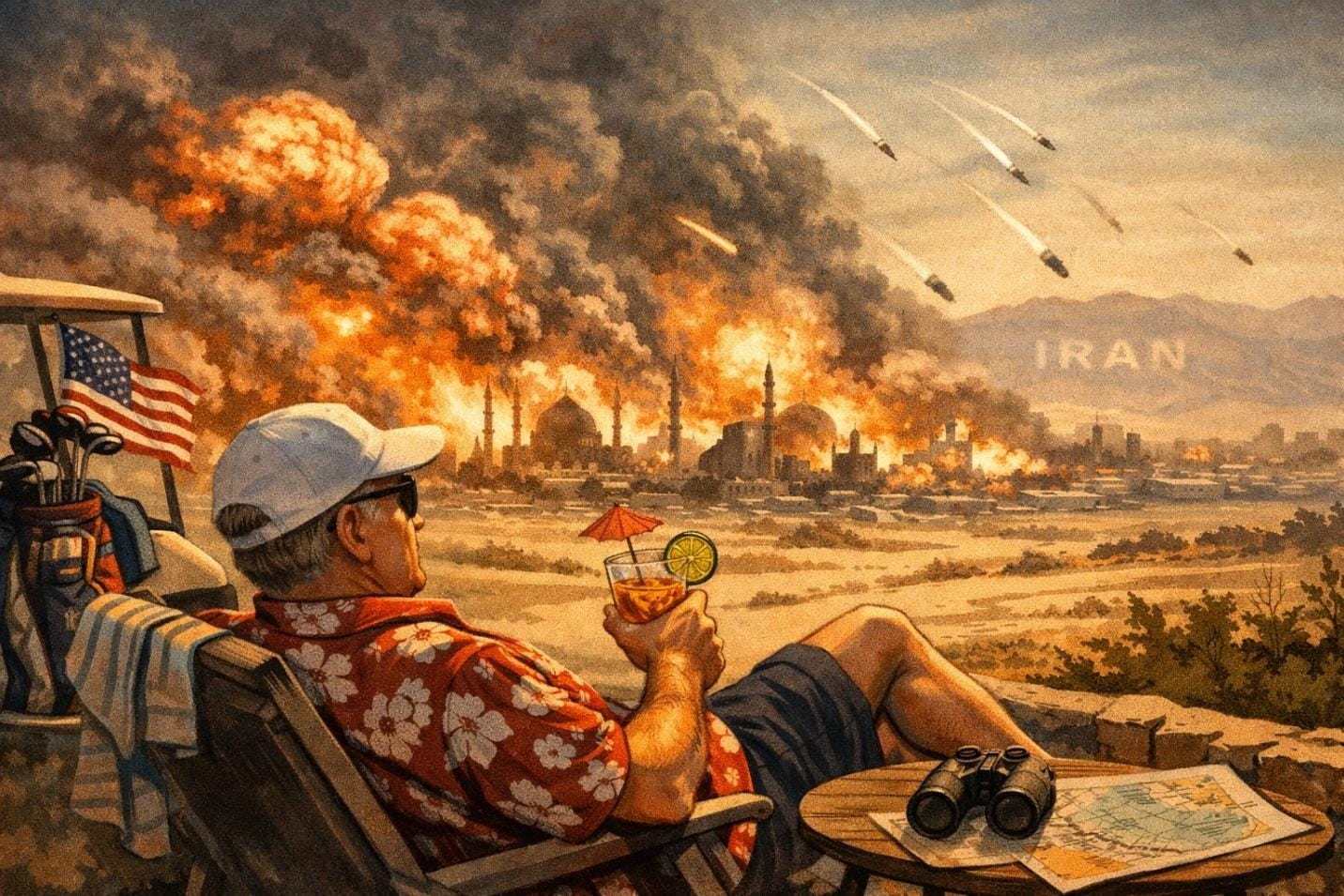
In March 2026, President Donald Trump described the military conflict with Iran as a “short excursion.” At other moments, he called it a “little excursion,” something less than a war but still necessary to prevent one. The phrase drew attention not simply because of its novelty, but because wars seldom conform to the names we give them. History suggests that conflicts announced as “limited” rarely remain so.
The president has also been unusually candid about how he makes decisions in moments like these. He emphasized that he trusts his instincts, his “feeling” about what needs to be done, more than the long briefings prepared by intelligence agencies.
There is nothing inherently wrong with intuition. Leaders have always relied on it. But instinct alone has never been the foundation of American national security decision-making. Institutions exist precisely because the stakes of their decisions, such as those leading to war, are so high.
Agencies like the Central Intelligence Agency and the United States Department of Defense spend enormous resources gathering information so that presidents can weigh evidence, risks, and options before acting. Gut instinct may help guide judgment, but it was never meant to replace the system designed to inform it.
The United States has heard promises of short wars before.
The invasion that began the second Iraq War was widely expected to be swift. Instead, it grew into a conflict that reshaped the Middle East and consumed nearly two decades of American attention and resources. The campaign in Afghanistan was also expected to be brief. I arrived in August 2004, and it had been raging for 2 years and 10 months. It became the longest war in American history.
These precedents are not perfect parallels. Every conflict unfolds differently with unique layers of complexity. But they do illustrate a consistent lesson: once military force is unleashed, events rarely follow the script written in Washington.
Calling the current conflict an excursion may make it sound manageable, even temporary. Yet the consequences of fighting Iran reach far beyond a single battlefield. Iran sits at the center of a region that shapes global energy markets and international security. We have already seen that escalation impact neighboring states and disrupt shipping through the Strait of Hormuz. It is sending cascading economic shock waves across the world.
Words matter when leaders describe war. Language shapes how the public understands what is being asked of them. An “excursion” suggests something controlled, almost routine. A war suggests sacrifice, uncertainty, and cost.
Perhaps the president instinctively believes this war will be contained. But history offers a warning that leaders ignore at their peril: the wars that reshape nations rarely begin as the wars they think they are starting. In 1914, Europe’s leaders expected a brief campaign. In Vietnam, escalation was described as limited and temporary. In Iraq, Americans were promised a swift and decisive victory. Again and again, leaders believed they could manage the risks and consequences. Again and again, the war proved far less manageable than the confident concepts that launched it.
That is the danger when a commander-in-chief approaches war as if it were an excursion guided by instinct. War does not reward impulses. It punishes them. It magnifies small misjudgments into national commitments and transforms confident assumptions into years of consequences. Once force is unleashed, the logic of war begins to take hold. Escalation, retaliation, momentum, and chaos are forces that rarely bend to the preferences of the leaders who set them in motion.
This is a war. The real question now is not whether the president believes he can keep the conflict limited, but whether events will allow him to. History suggests a sobering answer: once a war starts, the most dangerous moment is when the leader who launched it still believes he is the one in control.
Martha Duncan is a retired U.S. Department of Defense senior executive with 37 years of service, including 23 years as an officer in the U.S. Army Reserves, where she also served as Reserve Attache. She had three operational deployments to Panama, Bosnia, and Afghanistan. At DIA, she worked as a Latin American analyst for 11 years. A specialist in human intelligence (HUMINT), she is recognized for her leadership in intelligence operations, coalition-building, and enterprise-level policy development across the Defense Intelligence Agency (DIA), the U.S. Army, and the broader Intelligence Community. She grew up in Panama during the rise of Manuel Noriega and was instrumental in his capture.
Founded in 2016, The Steady State is a nonprofit 501(c)(4) organization of more than 390 former senior national security professionals. Our membership includes former officials from the CIA, FBI, Department of State, Department of Defense, and Department of Homeland Security. Drawing on deep expertise across national security disciplines, including intelligence, diplomacy, military affairs, and law, we advocate for constitutional democracy, the rule of law, and the preservation of America’s national security institutions.
Thank you for this! If only such observations --- based upon many years of professional experience & intellect ---were guiding decision-making in the Oval Office and the Pentagon's E-ring these days.
Thanks, Martha, for your post. What a pity that the Administration is oblivious to the realities they continue to ignore.