
Why Alliances Matter
The Steady State | Author's Name Withheld

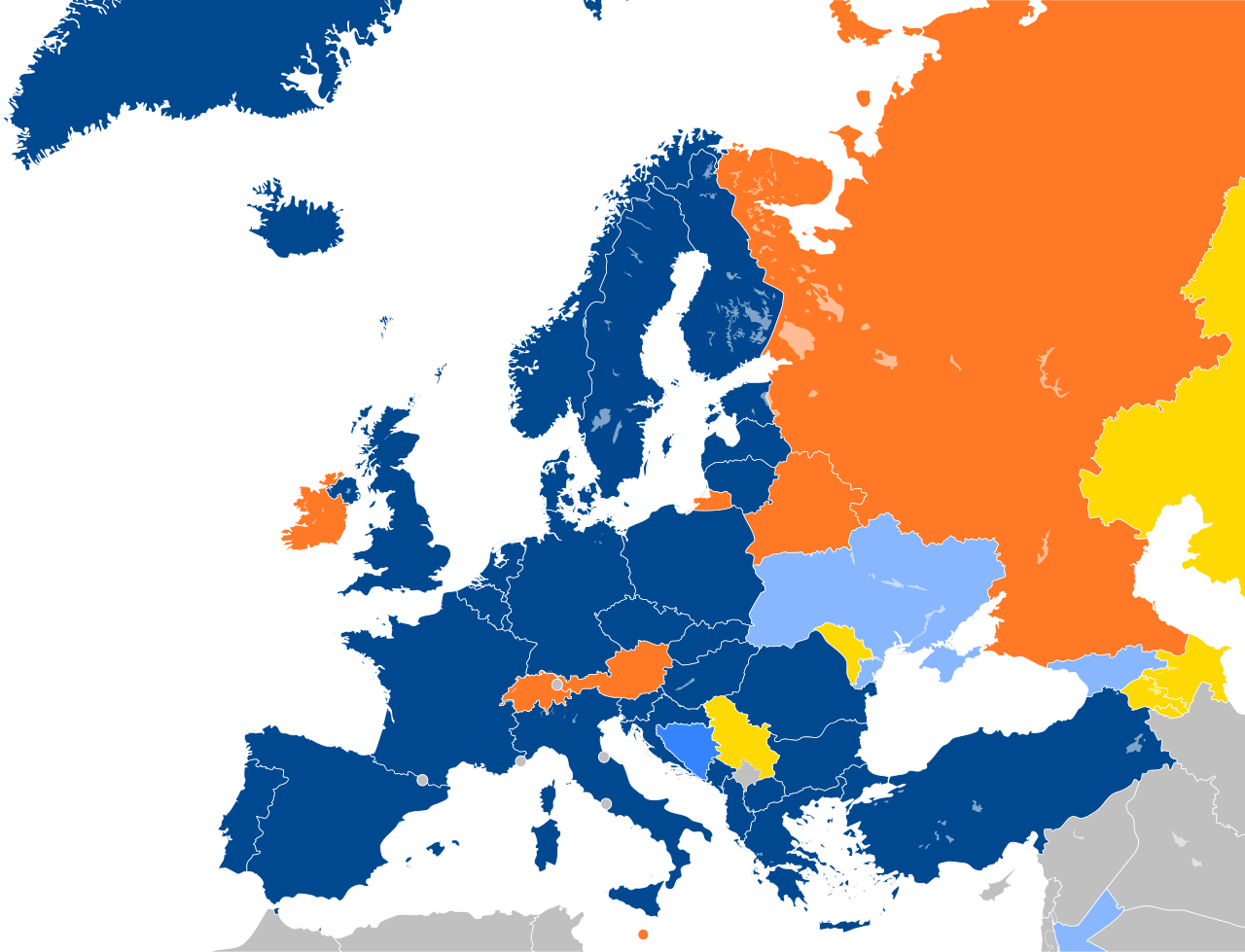
Major NATO Affiliations in Europe (2025)
The United States has long led the most successful, enduring alliances in modern history. The North Atlantic Treaty Organization has grown from 12 states in 1949 to 32 now. Its attraction to democratic states is well shown by the fact that all former members of the Soviet-led Warsaw Pact (except for the now-defunct Soviet Union) have joined NATO. The Alliance as a whole has grown in economic and military power over the years, but now it is profoundly threatened. And that threat might spread in time to our other close allies, Japan, South Korea and Australia.
The threat to NATO does not come from its original nemesis, the Soviet Union, or from Putin’s Russia. Instead it comes from the United States, the undisputed leader of the Alliance for almost 77 years. Until the past year, all Presidential Administrations had strongly supported NATO. In the early years, we worked hard for the political and economic growth of our European allies, knowing that their power would not threaten, but directly benefit, us. Increasingly in this century, American Presidents, Republican and Democratic alike, have called for greater burden-sharing from our now prosperous European allies. The allies have been slow to respond, but have greatly increased their defense spending in response to Russian aggression in Ukraine.
In berating our European allies, President Trump has sought to rewrite history to a degree worthy of George Orwell. He has called the European Union an enemy and said that it was formed to undermine the United States. Any student of modern European history knows that the United States strongly encouraged the creation of the first European Communities that ultimately led to the European Union. We believed, rightly, that unification would help Europe to prosper economically and work together peacefully. The United States so strongly supported European unification that Secretary of State Dulles called for an “agonizing reappraisal” of US-European relations after the French parliament voted against the proposed European Defense Community.
In his January 2026 speech at Davos, the President complained that “what we have gotten out of NATO is nothing except to protect Europe from the Soviet Union. I mean, we’ve helped them for so many years, we’ve never gotten anything.” He later publicly doubted whether NATO allies would come to the U.S.’ aid “if we ever needed them.” Article 5, the core provision of the NATO Treaty, provides that any “armed attack against one or more of them [NATO members] in Europe or North America shall be considered an attack against them all,” and that the members will take whatever means necessary to restore North Atlantic security. Is it actually possible that the President does not know that the Alliance has invoked Article V only once – after the 9/11 terrorist attack on the United States?
After Davos, the President said that “we’ve never needed them [NATO troops.] We’ve never really asked anything of them.” He added that “they sent some troops to Afghanistan,” but “they stayed a little back, a little off the front lines.” In reality, we asked for, and received, considerable NATO help in the First Gulf War and Afghanistan. Twenty-four NATO members sent troops to Afghanistan. The United States had the greatest absolute number of deaths, but Danish per capita losses were nearly identical to ours, and the United Kingdom and Estonia were not far behind.
U.S. entry into World War I marked a huge departure from traditional American policy, but we retreated into isolationism immediately after. Just over 20 years later, with the outbreak of the Second World War we learned what a huge mistake that had been. U.S. leaders after the war were determined not to repeat that error, and well understood that our safety and security was completely entwined with that of Europe and Asia. And the American people strongly agreed. At Davos, the President spoke about the war in Ukraine in terms that have not been heard from any responsible American politician since the 1930s: “What does the United States get out of all this work [on Ukraine], all of this money – other than death, destruction, and massive amounts of cash going to people who don’t appreciate what we do? … I’m talking about NATO, I’m talking about Europe. They have to work on Ukraine, we don’t. The United States is very far away. We have a big, beautiful ocean separating us. We have nothing to do with it.”
Of course, it gets worse. The President has periodically threatened to take Greenland by force. This would turn Article V on its head: if that happened, we would be the armed attacker. And on one of our closest, most steadfast allies. Moreover, the only reason for the United States to acquire Greenland is to satisfy the President’s real-estate-developer ego. He has publicly admitted that fact, acknowledging that the US-Denmark defense agreement allows us to build as many military bases in Greenland as we would like.
Official U.S. government policy toward our alliances in the President’s first term was very different, The December 2017 National Security Strategy stated: “Allies and partners are a great strength of the United States. They add directly to U.S. political, economic, military, intelligence and other capabilities. …allies and partners magnify U.S. power and extend U.S. influence. They share our interests and responsibility for resisting authoritarian trends, contesting radical ideologies, and deterring aggression.”
The 2017 National Security Strategy was drafted by a policy professional on the National Security Council Staff, and probably approved by the professionals who were the Secretaries of State and Defense, National Security Advisor and Director of Central Intelligence. Now those professionals are gone, replaced by sycophants who will neither oppose the President nor give him sound advice grounded in knowledge, experience, and a true understanding of U.S. national security interests. Further, the President now has moved right over to Putin’s and other authoritarians’ distrust of, and inability to cooperate with, proven allies. The result of all that is a dire threat to U.S. as well as allied, security that would have been unthinkable just one year ago. The only interests served are those of Russia and China.
During a 30 year career with the Federal Government, the writer served in the National Security Council Staff and State and Defense departments, and is now a member of The Steady State.
Founded in 2016, The Steady State is a nonprofit 501(c(4) organization of more than 360 former senior national security professionals. Our membership includes former officials from the CIA, FBI, Department of State, Department of Defense, and Department of Homeland Security. Drawing on deep expertise across national security disciplines, including intelligence, diplomacy, military affairs, and law, we advocate for constitutional democracy, the rule of law, and the preservation of America’s national security institutions.
Trump’s rambling at Davos was beyond embarrassing. I have no words. I look at intelligent and worldly leaders such as Carney, von der Leyen, and Frederiksen and I wonder what they think when they see and hear the likes of Trump. The sacrifice that NATO countries made on our behalf after 9/11 must not be forgotten. NATO is one of humanity’s single greatest achievements in modern times. Without it, the world would be a very dark place.
The Orange Monster is trying to convince us that our NATO allies have not been there for us as an excuse for him to sit back and watch should Putin decide to attack a NATO member nation. It breaks my heart to see him destroying our international relationships.